

|Annex Research | Annex Bulletins
| Quotes | Workshop |
Feedback | Clips | Activism | Columns |
The copyright-protected information contained in the ANNEX BULLETINS is a component of he Comprehensive Market Service (CMS) is intended for the exclusive use by those who have contracted for the entire CMS service.
IBM CORPORATE AFFAIRS (1991)
A Retrospective: John Akers' Six+ Years At the IBM Helm
Akers: The Last Emperor?
Corporate Boards Getting Tougher With CEOs; Will IBM's?
PHOENIX, June 12, 1991...
John Akers' "public
flogging" of his senior management certainly brought about a myriad of
reactions -- both within, and outside IBM.
Some were quite favorable; others chastised IBM's chairman for trying
to shift the blame on others for the problems which happened on his watch.
Such contrasting views usually call for a longer-term context of the
events which led to Akers' outburst. When
we first set out to do this type of analysis, we were determined to provide
a balanced view of his years at the IBM
helm. For that reason, we
offered to meet with Mr. Akers. Through
a spokesperson, however, he declined the offer.
Consequently, IBM's chairman chose to leave his record to speak for
itself. Which, as you are about
to see, almost guaranteed a depressing story, albeit a balanced one. In
this report, we start the clock in 1983, when Akers became IBM's president.
Our stopwatch ends today, albeit only figuratively.
For time is running out on this IBM chairman, despite his frantic
efforts to stop the IBM game clock. As
you can see on page
6, overall, we rate his six-year performance as a
"D." From the purely
financial standpoint, however, it is a clear "F!"
Even a complacent Board as IBM's has been, therefore, will find it
increasingly uncomfortable to keep ignoring their chairman's disappointing
track record.
A Blank Check?
In late April of this year, a well-known New York financier asked me an unusual question: "Suppose, Bob, the IBM Board were to hire you as a special consultant, to advise them on strategy, or something like that... Suppose they called you in, gave you a check and asked you to fill in the blanks. Would you do it?" 'What a far-fetched question!', I thought to myself. "That would never happen under Akers," I replied out loud. "I know, I know... But, let's just suppose it did," our client persisted. "Would you do it?"
Our answer to the above question isn't important. What's important is that the question was being asked in the first place; that it was being asked by a person of considerable clout and stature; that this conversation took place well before the now famous Akers outburst became publicly known (in fact, it may well have been even the very day Akers was admonishing his team).
In other words, the question implied that if, in this person's opinion, the IBM Board could use an outsider's advice, something must be wrong with the insiders' strategies. And not just a little bit wrong -- a blank check's-worth of a wrong!
The Complacent Board?
Yet, one would never get that impression if one listened to the public statements by some of IBM's board members. Irving Shapiro, for example, a former IBM board member, was quoted in a recent interview with Business Week as saying, "I applaud what IBM is doing. The only issue is: How productive is it?" Richard Lyman, an old-timer on the IBM board (since 1978) and a former president of Stanford University, said that Akers has "the full confidence of the board."
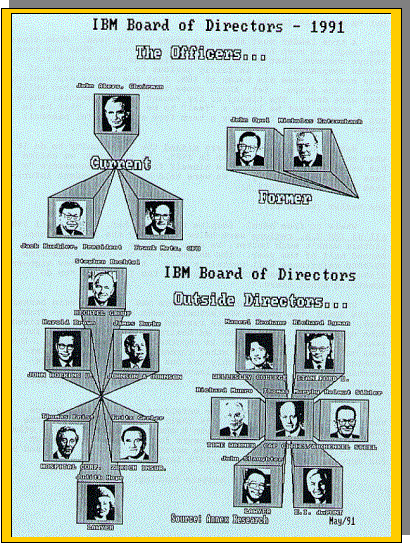
It would not be perhaps surprising to hear the above votes of confidence by IBM's former and current board members in light of Akers' remarks at the IBM Annual Meeting in late April. Speaking in Kansas City, IBM's chairman once again told his shareholders that the company "...is continuing to invest for growth," that he and his team "are managing the business with prudence to generate increasingly attractive financial returns."
Sounds good. Except that this is not the first time Akers has promised the shareholders growth while delivering declines. As a matter of fact, he's been doing that, on and off, for most of his six years as IBM's head (see APPENDIX A -- an historical perspective of Akers' years). For example, at the 1985 Atlanta Annual Meeting (his first as chairman), Akers promised the shareholders a year of "solid growth." Yet, in just over six weeks, as a matter of fact, on this very day six years ago, he recanted his earlier prediction and told a group of financial analysts gathered at IBM's Yorktown Heights facility in New York that such "solid growth" isn't going to happen (in 1985 -- see APPENDIX A). Considering that this happened when Akers was only a "rookie" chairman, one might have been tempted to give him some leeway. Now, after more than six years in the job, glossing over IBM's problems is less acceptable. As is his apparent "double talk."
We now know, for example, that Akers' outburst to a class of IBM's middle managers occurred only days before the IBM Annual Meeting. So what? "There's no fun in having the stock at 25% discount. There's no fun in being a no growth business..." was what Akers told the IBMers. "Shareholders are unhappy and I don't blame them." One would think, therefore, that he and the directors, who get paid to represent the shareholders, would feel the same way publicly? After all, isn't there only one IBM?!
Consider this: within days of yelling at his management team "WHERE"S MY RETURN FOR THE EXTRA 5,000 PEOPLE? WHERE'S THE BEEF? WHAT THE HELL ARE YOU DOING FOR 'ME?'," Akers told the IBM shareholders that "the difficulties we're dealing with reveal that the IBM company is strong...;" that "our people, the quality of our resources; we have never been in a better shape." Wow! Will the real IBM please stand up!
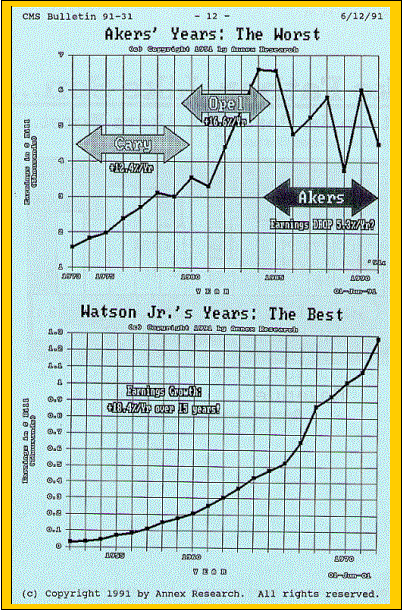
The two votes of confidence, therefore, by the IBM directors quoted in the BW story are even more amazing considering that they were made after Akers' outburst became public; after IBM turned in a terrible first quarter score card; and after a decade of the worst results in the 78-year history of the IBM company (see the charts and tables 1-5). The fact that the IBM Board members are evidently putting a coat of paint over Akers' own glossy statements, despite his track record of unfulfilled promises, makes one wonder if the whole Board isn't being complacent? And if the public company officials should get charged if they (intentionally?) misled the shareholders?
A recent Wall Street Journal article entitled "More Chief Executives Are Being Forced Out By Tougher Boards" cited several cases where the boards had eventually acted in the shareholders' best interests. But only after they had received "intense heat from the regulators, stockholders or the media." The report concluded that, "even the tough-minded directors usually lack the time, the information or expertise to confront management." Well, after this CMS BULLETIN, the IBM Board members won't be lacking at least one of the three missing ingredients.
Analysis of Akers' "Report Card:" The Three "A's"...
Management Skills. As
can be seen from A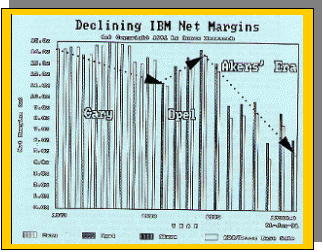 kers'
"Report Card" table on page 6, IBM's chairman scored well in
terms of his management skills (a "B" overall).
We see his ability to focus on a simple goal and to communicate it
clearly to IBM's casts of thousands as one of his personal strengths.
This ability earned him one of the three "A's" on his
performance chart.
kers'
"Report Card" table on page 6, IBM's chairman scored well in
terms of his management skills (a "B" overall).
We see his ability to focus on a simple goal and to communicate it
clearly to IBM's casts of thousands as one of his personal strengths.
This ability earned him one of the three "A's" on his
performance chart.
In 1987, for example, he did just that with his "year of the customer" theme. Notwithstanding some competitors' jabs at it (DEC, for example, said that "at DEC, every year is the year of the customer), Akers showed that he was able to communicate clearly and succinctly to IBM employees the need to focus once again on the outside world. This, by the way, is consistent with his views at the time he became IBM's chairman. In an interview with the New York Times in January 1985, he said that he expected to spend a lot of time on "external affairs" (see APPENDIX A).
In 1988, Akers repeated this management feat as he urged IBM's people to orient their thinking away from IBM products, and toward the customer "solutions." Therefore, one could rightfully dub 1988 as "the year of the solution" -- as we did contemporaneously in one of our CMS BULLETINS (see APPENDIX A).
1988 was also the year in which Akers earned the second of his three "A's" -- the one for organizational effectiveness. In January of that year, he busted up the IBM highly-centralized management hierarchy by creating the "lines of business" (LOB), and giving their heads more authority. He also told his senior executives that they can expect to stay in their jobs much longer than before, thus ensuring more continuity. And he encouraged IBM people to think globally, which facilitated a greater influence on decision-making of its international segments.
Akers earned the third of his three "A's" for his commitment to excellence. The results of the changes which Akers had brought about -- the customer orientation, global solutions and commitment to excellence -- became clearly visible in late 1990. IBM's "market-driven" product lines looked to be in the best shape they have even been! And IBM's Rochester AS/400 plant and lab received the Malcolm Baldridge award for excellence.
By the way, Akers' three "A's" have one thing in common -- they are trademarks of a good salesman. Which is how Akers got the job in the first place. But, as can be seen from the rest of his scorecard, being a good salesman is only one of the qualifications required for a top-notch CEO.
For the most part, we thought that Akers' management decisions passed the test of "common sense," which is why we rated his performance as a "B" in this category.
The rest of Akers' "report card" goes all downhill. Downhill from the "A's," that is. Even within the management skills category in which he scored the best, he had demonstrated a lack of vision with respect to grasping the industry trends, or IBM's product strategies. Think of the "rent-to-purchase" conversion fiasco, for example. IBM's mid-range product line mess in the mid- to late-1980s, IBM's lateness in coming up with the PS/2, having to be dragged kicking and screaming by the market demand into the UNIX world -- are some of the examples why he only earned a "D" in these categories.
Analysis of Akers' "Report Card:" The Rest...
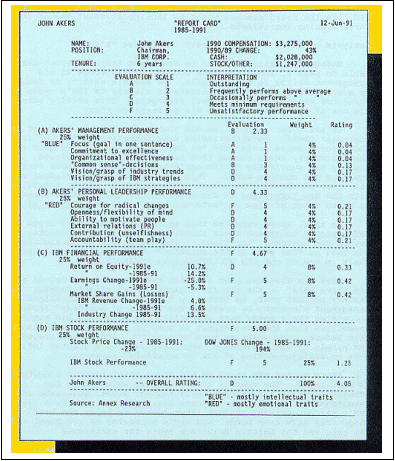 Personal Leadership. In
the personal leadership category, Akers scored a resounding "F."
Take his stubborn adherence to IBM's "no layoff" policy,
for example (also see APPENDIX A for additional examples). With the IBM ship listing under the weight of its huge
Selling, General and Administrative (SG&A) expense bulk ($20.7 billion
in 1990), Akers was boasting to his shareholders about the 14,000 fewer
jobs which would reduce the IBM expenses by "$400 million next year,
rising to $600 million in 1993 and beyond!?"
Yet, $400 million is only 1.9% of the (1990) SG&A expenses. And the IBM shareholders will have to wait till 1992 to feel
the effect of it!
Personal Leadership. In
the personal leadership category, Akers scored a resounding "F."
Take his stubborn adherence to IBM's "no layoff" policy,
for example (also see APPENDIX A for additional examples). With the IBM ship listing under the weight of its huge
Selling, General and Administrative (SG&A) expense bulk ($20.7 billion
in 1990), Akers was boasting to his shareholders about the 14,000 fewer
jobs which would reduce the IBM expenses by "$400 million next year,
rising to $600 million in 1993 and beyond!?"
Yet, $400 million is only 1.9% of the (1990) SG&A expenses. And the IBM shareholders will have to wait till 1992 to feel
the effect of it!
Underscoring Akers' inflexibility of positions -- "shooting the messengers of bad news" -- is how one of IBM's employees described his style (see APPENDIX A and CMS BULLETIN 91-30, 5/28/91). His continued unwillingness to consider (contrary) outside viewpoints underscores the very arrogance which he claims he would like to see eliminated within IBM (see our 1986 correspondence with him on page 8 and APPENDIX A).
As for his ability to motivate people, accountability (i.e., being a "team player"), or external relations success, the latest outburst has only revealed to the outside world what the insiders have been seeing and feeling for some time: that Akers isn't cutting the mustard in any of these categories.
Financial Record. In terms of his financial record, IBM's chairman rates an "F" in nearly all categories. The fact that the IBM stock price is down 23% since the time he took over as chairman, while the Dow Jones industrials' index is up 194% during the same period, requires no further comment. IBM's other financial measurements, such as the net earnings change, the return on equity, or market share gains/losses -- are all similarly disappointing.
COPY OF DJURDJEVIC/AKERS' 1986 CORRESPONDENCE (chart)
Not "A Natural" (Leader)
A true leader must always be ahead of his team. When times are tough, he must be supportive of his players. When the team enjoys success, that's the time to "kick ass," so as not to become complacent. It is fairly obvious to everyone that, at this moment, times are tough at IBM, that the people are feeling down in the dumps. Yet, Akers chose to kick some of them while they were down. The timing of his recent harsh comments, therefore, proves that he lacks a "feel" to be a leader, that he is not "A Natural" -- to borrow a term from a successful baseball movie.
Making things worse, Akers missed the opportunity to do it when he took over as chairman in 1985. At the time, we called his unwillingness to distance himself from his predecessors "a lack of political savvy." We were told that our comment infuriated him (see APPENDIX A).
Quo Vadis? (Where to?)
Where to from here? Despite the fact that, as of April 1991 all 64 IBM U.S. regions were below plan, and the international picture wasn't much better, we expect things to improve in the second half of the year. The shipments of the top-of-the-line ES/9000 mainframes will certainly help. As will the new high-end disks. This will ease the pressure on the IBM Board "to do something about Akers."
On the other hand, this year Akers has lost his main backer on the Board, the person who actually made him the CEO -- Frank Cary. The former IBM chairman reached the age of 70 and retired. John Opel, Akers' predecessor as chairman, still has about four years left on the Board, but is reportedly not very active. The same can be said about the other former insider, Nicholas Katzenbach, who additionally only has one more year left before reaching the age of 70. This leaves Akers with his own two insider appointees to the Board -- Jack Kuehler and Frank Metz -- versus 13 outside directors.
In other words, should the outsiders on the Board decide that it is time for them to take their duties on behalf of the shareholders seriously, Akers won't stand a chance. On the other hand, it would take extreme pressure for the outsiders to act tough -- something that they have never done before. So stand by for more excitement at the world's largest computer vendor.
Happy bargain hunting!
Bob Djurdjevic
APPENDIX-A: AKERS' RETROSPECTIVE
(as seen through ANNEX's reports, press clips)
1
9 8 3
THE FORMATIVE YEARS
PHASE 1: INDOCTRINATION & DELUSION...
Feburary, 1983: John Akers becomes IBM president.
--------------------------------------------
March,
1983:
"IS IBM MORTGAGING ITS FUTURE?"
(Annex Computer Report; Apr/83 issue):
"...As long as there is a steady and increasing demand for its products and services in the future, this IBM strategy (expansion) should continue to work... But, IBM's challenge is going to be that of forecasting such growth accurately. In 1977, the company underestimated the effect which aggressive pricing of its 303X had in generating demand for its products...In the 1980s, IBM must make sure it does not become too optimistic in assuming its lower prices will automatically generate user demand... by shifting the emphasis from rental to purchase revenues, IBM is becoming more vulnerable to the general economic conditions and year-to-year fluctuations."
--------------------------------------------
April,
1983:
Opel on Cary: "Remarkable Display Of Business
Courage and
Confidence"
(Annex Computer Report; Jun/83 issue):
In a tribute to the outgoing chairman at IBM's 1983 Annual Meeting in Boston, IBM's (now also retired) chairman John Opel praised Cary for his "remarkable display of business courage... and confidence," and for "setting our growth strategy." Opel also lauded Cary for his confidence "that the great opportunities which we saw before us would be translated into actual demand."
"...ACR (Djurdjevic) asked the IBM Chairman (Opel) to explain why IBM achieved this (financial) turnaround, in part, by borrowing from its future? Mr. Opel pointed out the increased significance of IBM's service revenues... and the IBM Credit Corp. (ICC)... In conclusion, Mr. Opel told ACR (Djurdjevic) "we have reasons to be optimistic about out future."
--------------------------------------------
May,
1983:
Krowe: "Purchase Is a Natural Order of Things!"
(Annex Computer Report; Jul/83 issue):
"After the IBM shareholders meeting
in Boston... John Opel asked Mr. Allen Krowe, IBM's Senior VP and Chief
Financial Officer, to handle our concerns (regarding the lease base
sale)... Krowe attributed the reason for a change to customer preference.
'So, you are saying that the shift to purchase was not IBM-driven,
but was market-driven?' ACR (Djurdjevic) asked.
'That is correct,' Krowe replied... He did agree though with our
assertion that this would lead to 'greater period-to-period fluctuations,
and therefore, pose an increased requirement for accurate demand
forecasting.' But, he also
added that IBM's recent performance suggests
that the company is relatively insulated from the influence of negative
worldwide economic factors (such as the current recession)."
--------------------------------------------
July,
1983:
"A Headstart or a Legacy?"
(Annex Computer Report; Aug/83 issue):
"Once notorious for its product shortages, the world's largest computer company may face the reverse problem of having to figure out what to do with excess manufacturing capacity. In recent years IBM has added $10 billion-worth of new plant and lab facilities, or two thirds of its assets. Such a massive investment is evidence of a massive dose of confidence about the future which IBM's chairman, Frank Cary, possessed. The next three years will show whether IBM's new chairman, John Opel, received a headstart or a legacy from his predecessor."
--------------------------------------------
1
9 8 4
March, 1984: Akers First Speech to Analysts: "Need to Be More Forthcoming;" Aggressive Capital Investments" (unpublished until now)
At the IBM meeting in Boca Raton, FL, IBM's president, John Akers, started his first public address to financial analysts by saying that IBM understood "our need to be more forthcoming about our business, unlike some of the press reports" (about IBM). Answering one analyst's question, Akers said that "much of the success today has been a result of our capital investments over the last five years. We will continue to be aggressive" (in this respect)... Meanwhile, IBM's Krowe contradicted himself from his above May 1983 remark as he said that the "poor economic conditions worldwide" represent the biggest threat to IBM's otherwise optimistic growth plans.
--------------------------------------------
April,
1984:
Opel: "Unit Shipments at An All Time High!"
(Annex Computer Report; Jun/84 issue):
"ACR asked IBM's chairman (at the IBM Annual Meeting in Los Angeles, CA) why IBM refuses to disclose to its shareholders the unit shipments by product lines, in light of the fact that rental-to-purchase revenue conversion is distorting the period-to-period comparisons. '... We are not withholding this information from the shareholders... I can assure you (slight pause), I don't believe that this (type of disclosure) would change anything in our results. Our physical shipments of goods are at an all time high."
--------------------------------------------
November,
1984: IBM's $6 Billion Inventory:
Sign Of Weak Demand?
(CMS BULLETIN 84-21, 11/20/84)
"...IBM has overestimated the demand for its products and now has to stockpile about $6 billion-worth of them. What does that mean? More price reductions, as IBM once again attempts to stimulate the demand..." (Re. rent-to-purchase conversions): "...He who plays with fire, sooner or later gets burned by fire. When deciding to give up the protective cushion of its rental income, IBM executives began playing with fire. The negative consequences are already beginning to show up, and will become even more visible by 1986, when most of IBM's rental revenues will be gone."
--------------------------------------------
PHASE 2: DOUBT...
December,
1984: Puckett: "Never Suspected
Anything Till Late 1984"
(CMS BULLETIN 90-30, 7/19/90):
Bernard Puckett, currently an IBM vice president in charge of its Application Solutions line of business, was in charge of plans and controls at IBM reporting to Allen Krowe in early 1984. When told in February 1990 of our analysis regarding IBM's rent-to-purchase and the overexpansion strategies, and the subsequent question we asked John Opel at the April 1984 IBM Annual Meeting, Puckett said "he wouldn't have known it then. We never suspected anything until late 1984. That's when we started wondering if something went wrong."
--------------------------------------------
1
9 8 5
January,
1985: Rentals
Declining Faster Than the Growth in Service Revenues
(CMS
BULLETIN 85-04, 1/21/85)
"... IBM's slower revenue growth
rate in the second half of 1984 was also due to a relatively new
phenomenon. IBM's service
revenues (which include software revenues) were not rising as fast as its rental
revenues are declining. During
1984, the company's combined rental and service revenues declined
4.3% as compared to 1983, the second consecutive year in which such a drop
took place... 1984 was also the second consecutive year in which IBM's
'business volume,' (the "if sold" value of its hardware
revenues) declined. The rate
of decline (-0.3%), however, was lower than in 1983 (-1.0%).... In the
last quarter of 1984, IBM's overall revenues increased only 12% over the
fourth quarter of 1983, the lowest rate of growth since the first quarter
of 1982 -- the quarter during which the Justice Department ended its
13-year antitrust suit against IBM... For the first time, IBM warned that
'if the strong dollar continues at the present level, it will impact 1985
non-U.S. revenue growth as reported in dollars, particularly in the first
six months.'"
1985: The Last Year Of Rent-to-Purchase Conversions "...Besides the continued threat to IBM's revenues which the strength of the U.S. dollar represents, 1985 will probably be the last year during which IBM will benefit from the one-time sale of its rental inventory. To offset the resulting downward drag on its revenues, IBM will have to continue to grow its service revenues. And that means likely software price hikes, combined with an increased preponderance of one-time charges (as op posed to monthly license fees)."
--------------------------------------------
PHASE 3: DENIAL...
February,
1985: John Akers becomes
IBM chairman and CEO.
(NEW YORK TIMES, 1/29/85)
"... In a broad interview, Akers predicted that within a decade IBM (revenues) would pass $180 billion a year (at the time, IBM revenues were $46 billion [1984]; Akers himself was 50 years of age, looking ahead to probably a decade-long career as the chief executive)... I worked under Frank Cary and John Opel for 15 years,' a relaxed, confident-sounding Mr. Akers said in a recent (NYT) interview... I've had just about every experience in the business -- service, marketing, Federal business, world trade... I feel pretty well prepared.'"
Focused on External Relations. "... Indeed, on first meeting, Mr. Akers appears as a charismatic champion of what he terms a 'new IBM'... Mr. Opel, in contrast, stressed in an interview last month the themes of continuity in the company. Moreover, Mr. Akers indicated that he plans to devote more time to explaining IBM's actions. '...I should be prepared to spend maybe as much as half my time in external affairs as opposed to internal management.'"
--------------------------------------------
April,
1985:
Pulling the Rabbit Out of a Hat Can Be Hard To Do; Akers Feeling the
Heat?
(CMS BULLETIN 85-20, 4/11/85)
"... A closer look at IBM's first
quarter results shows that, even for the best of magicians, pulling the
rabbit out of the hat is a hard thing to do if you had eaten it for supper
the previous night. In order
to make itself look good in 1984, IBM made many software and some
maintenance special offers to its customers giving them a chance to get
the software for one-time fees payable in 1984 in lieu of the continuous
monthly payments. Now that
this source of continuous cash is gone, IBM's service revenues in the
first quarter increased only 11.7% since a year before, a far cry from the
torrid 25% pace at which they grew in 1984."
"While in Opel's case there may have been some room for hope that Cary had given him a headstart rather than a legacy, there is no doubt that Akers, who has taken over from Opel, is already feeling the heat. It is perhaps ironic that IBM's new CEO will end up sleeping in the (hot) bed that his predecessors had made. But then, not only is he handsomely compensated for it (he got a 91.2% raise in 1984), but he was also around to watch them make it before jumping in."
--------------------------------------------
April,
1985:
Akers Predicts "Solid Growth" in 1985, A "Trillion Dollar
Industry" by 1990s.
(WALL STREET JOURNAL, 4/30/85)
Speaking to the IBM shareholders at the company's Annual Meeting in Atlanta, Akers said that "the company expects 'solid growth' in 1985 profit and revenue... Akers also said that, 'it is predicted that industry revenues should continue to double every five to six years, which means that by some time in the 1990s, we'll be operating in a trillion dollar industry...'"
--------------------------------------------
PHASE 4: SLOW AWAKENING, YET CONTINUED DENIAL...
June,
1985:
"Big Blue" Now Also Singing Blues
(CMS BULLETIN 85-34, 6/18/85)
"In a change of tune from his previous optimistic remarks, IBM's chief executive, John Akers, told a group of financial analysts assembled at the IBM Yorktown Heights research lab on June 12 that the "solid growth" in 1985 isn't going to happen. Only six weeks earlier, Akers assured IBM shareholders at their annual meeting in Atlanta that, `despite what appears to some as a pause in our industry....I am confident that we will enjoy solid growth in revenue and earnings for the year as a whole.' In less than two hours of trading which remained following Akers' change of tune, IBM stock dropped five and a quarter points on a volume of over 2.5 million shares -- as New York Stock Exchange's most active issue."
"Akers blamed the strong dollar and the weakness of the U.S. economy for the slowdown in IBM's rates of growth.... Upon conclusion of his speech, I asked him if he would explain how a strong U.S. dollar has anything to do with the weakness of demand in the U.S. After a few exchanges and clarifications as to what my question really was, Akers conceded that, 'if you want me to say that the foreign currency translations do not affect our U.S. results, I'll agree with that.'"
"...On balance, therefore, Akers' explanation that the softness in demand for IBM products stems from an alleged "weakness of the U.S. economy" fails the tests of global and historical consistency. From the preceding statistics, one would conclude that there is no correlation whatsoever between the economic rates of growth and the demand for IBM products. Which means that IBM's economic theory may be no more than a face-saving tactic, a red herring intended as a diversion from three real problems. Since all of them are self-made, they are now possible topics of embarrassment for IBM executives. As such, they are better left untouched."
Are Users 'Overmipped?' "...IBM's unprecedented high levels of capital spending are the second most important reason for the company's present woes... (Akers') implication that it is the 'industry's' overestimation of demand that has led to the current overcapacity problem. What IBM's CEO failed to point out, however, was the fact that IBM's own capital spending of $16.5 billion dollars during that period accounted for a lion's share of 'our industry's' capital investments. Given the fact that, in Akers' own words, `there is clearly overcapacity' in the industry, one would think that IBM might start pulling in its horns when it comes to capital spending. Instead, Akers told the analysts that he expected IBM's capital spending this year to exceed that of 1984 by 20%!? 'This should remind you of the confidence which we at the IBM company have in the future,' he added. Actually, what this reminds this writer of is an ostrich which, in the hope of avoiding danger, sticks his head in the sand."
Akers' Lack Of Political Savvy. "The June 12 (1985) meeting with financial analysts was an ideal opportunity for IBM's newly appointed CEO (Akers assumed this position only last February) to clear the slate; to admit to IBM's past mistakes; to distance himself from IBM's former CEOs (i.e., John Opel and Frank Cary who should probably shoulder most of the blame for IBM's current lackluster results); to reassure both IBM's customers and shareholders that he has learned from their mistakes, and that the company would be turning a new, and a more prudent leaf from now on. By failing to seize this opportunity to send such signals, Akers has demonstrated not just that he was equal to his predecessors as a poor judge of demand, but also that he lacked political savvy. For, unless IBM users suddenly rush to IBM's rescue, the lower-than-expected demand in the computer industry may ultimately ruin his own credibility. You see, given the 20% to 25% average annual price/performance improvements in the industry, a 20% growth rate in unit shipments (which he predicted for 1985) will mean flat revenues at best, instead of the 'solid growth,' which Akers promised earlier."
"... As can be seen from the preceding, the universe is unfolding as it should. The GNP and the computer industry are growing, albeit not necessarily as fast as IBM promised its shareholders. It remains to be seen if those who made such promises will ever be held accountable for their mistakes."
--------------------------------------------
August,
1985:
IBM's Inventory Doubles in Two Years
(CMS BULLETIN 85-45, 8/27/85)
"...By the end of June 1985, IBM's bulging inventories reached an all-time high of $7.97 billion, an increase of $1.4 billion in just six months.... In just two years, therefore, IBM's inventory has more than doubled... It is evident that IBM is hoping to be able to outsell the current slowdown in the industry, rather than have to take the knife to its overexpansion problem. The next six months will give us a good indication whether or not this can be done. But, even if IBM does succeed in reducing its inventories, in today's buyers' market it will have to drop the prices to stimulate the demand."
--------------------------------------------
November,
1985: IBM Starting to Tighten Its
Belt
(CMS BULLETIN 85-51, 11/08/85)
"...At the November 6 meeting of European financial analysts in Greenock, Scotland, the top IBM executives, notably Allen Krowe, its chief financial officer, reportedly stressed the importance of "prudence" in cost control. As a result of attrition and its recent reorganization (see CMS Bulletin 85-47), IBM's overall U.S. employment is expected to decrease during the fourth quarter of 1985, they said."
"...At the Greenock meeting, for the first time in at least the last six years, IBM executives also hinted at starting to cut back on their capital expenditures. Some of the capital projects planned for 1985 will be postponed, according to Krowe. Although IBM's CFO made great efforts to play down the significance of these cutbacks, it is clear that they have been caused by the relative weakness in demand in the U.S."
--------------------------------------------
1
9 8 6
PHASE 5: REALITY SLOWLY SETTING IN...
January,
1986:
Akers: "Approaching 1986 With Caution"
(CMS BULLETIN 86-05, 1/29/86)
"...Commenting on the 1985 results, Akers said that, "there is an absence of convincing evidence (that) the North American economy is showing sustained improvement, and we are approaching 1986 with caution." IBM CEO's words of caution signal a change from the company's bullish long-term posture a year ago. They are an indication that the reality of IBM's (mis)judgment of demand is setting in at Armonk, if not yet on Wall Street. And that's a positive sign, as the industry moves through a phase of growth correction."
--------------------------------------------
May,
1986:
Capital Spending Slows
(CMS BULLETIN 86-25, 5/29/86)
"...Another piece of good news for IBM is the fact that after years of spending billions (over $20 billion in the last six years) on new plants and equipment, IBM has finally started to curtail its capital spending. Largely due to the projects already under way, this year's capital spending plan is likely to be flat compared with that in 1985."
--------------------------------------------
June,
1986:
Why Is IBM Opening Up?
(CMS BULLETIN 86-29, 7/07/86)
"... After decades of almost air-tight controls of its captive markets, there is a breath of fresh air in IBM's strategies. IBM seems to be opening up to the world in more ways than one. First, the company's senior executives, led by its new chairman, John Akers, exhibited an unusual air of openness at last month's meeting for financial analysts in San Jose. Second, IBM is also opening up its SNA communications strategy."
"... What is the reason that IBM may be opening up to the world? In a word -- it is its growth. Or a lack thereof if the company did not open up. The recent comments by the senior IBM executives suggest that they are finally coming around to correcting the flaws in some of their product strategies from the early 1980s. One of them was the assumption of a continuous 50%+ MIPS demand growth, fueled by the (high) PC shipment volumes... As we know now, that didn't happen... Asked by ANNEX (Djurdjevic) at the San Jose meeting if IBM is opening up its communications strategy because the company thinks that such a move would help the growth of MIPS demand, Terry Lautenbach left no doubt about it. 'Of course,' is all he said. Later, Akers expanded on this by saying that, 'the more devices, ours and theirs (meaning those of IBM competitors) we can have connected to our systems, the better for our business.'"
Systems Integration/Solution Selling: New Role/Old Tactics "...Network management and systems integration are vital components in determining eventual winners and losers (in the computer and communications industry)," said IBM's Lautenbach. "We intend to win." In other words, it is through its new role as "the world's best systems and network integrator" that IBM will try to regain some of the control which the company has lost by opening up the SNA gates to the outsiders. Interestingly, there is not much new to IBM's "new" marketing strategy. IBM is still the same old friendly computer supplier which was selling solutions, while its competition was selling products... The only difference from the past, therefore, is that IBM is now also including its communications products among its solutions. As of July 1, 1986, there were 60 marketing teams selling integrated IBM/Rolm solutions worldwide. By the end of the third quarter, however, that number will increase to 100 teams."
Akers Doesn't Think IBM Has An Inventory Problem?! "... Just as we were ready to give the IBM chairman high marks for putting on the breaks on capital spending, for dropping prices to reduce IBM's bulging inventories, Akers said something which indicates that he still may have some of IBM's old arrogance left in him. Answering a question from the floor, IBM chairman said that he didn't think that IBM had an inventory problem. "We are managing it carefully, but I don't think we have an inventory problem." Well, if Akers really thinks that IBM's $9+ billion inventory at cost, over $30 billion at retail, double the level it was only two years ago, with finished goods leading the rise with a 48% year-over-year jump since March 31, 1985 -- can be wished away by a simple declaration that it is not a problem -- why would IBM then be dropping its prices so aggressively trying to sell it off? "Action speaks louder than words," somebody once said."
--------------------------------------------
November,
1986: Djurdjevic to Akers: How
Open-minded Are You Really?
(correspondence unpublished until now -- see the charts)
Following a series of customer workshops in North America and Europe, Djurdjevic wrote to Akers offering to share with the IBM chairman some of the feedback he'd received from IBM customers. "I thought that having a fresh, new perspective of the IBM company may help your executives understand how they are really perceived by the outsiders," Djurdjevic's October 30, 1986 letter said. "And that, in turn, may help you mold a new image for IBM, one which would have an Akers' personal imprint on it, and one which would last well beyond your tenure as IBM's chairman." In his November 17, 1986 reply, Akers turned down the offer.
--------------------------------------------
November,
1986: Akers Takes Notes While
Customers Speak
(CMS BULLETIN 87-30, 5/31/87)
"...In a special report entitled "IBM Renews Its Commitment To Customer Partnerships," IBM's PR people explained how IBM reawakened to the importance which its customers had.... In November 1986, the pro-customer movement 'gathered momentum at an unprecedented IBM strategic planning conference in Purchase, N.Y.,' according to the IBM report. The conference site selection notwithstanding (you see, "Rent, N.Y." had lost some of its lustre in recent years), what made it unprecedented was that Akers invited top executives from six customers in the U.S., Canada, Switzerland and Japan. He then sat back 'to listen, and (to) learn, as customers took the floor.' Akers reportedly took notes throughout..."
--------------------------------------------
1
9 8 7
("THE YEAR OF THE CUSTOMER")
PHASE 6: NEW IDEAS TRIED...
January,
1987:
IBM Earnings Disappoint Even Worst Pessimists
(CMS BULLETIN 87-05, 1/23/87)
"... IBM's (1986) earnings report disappointed even the worst skeptics.... IBM did say that its inventory dropped 10% during the fourth quarter. IBM also confirmed that there was an inventory write-off within its cost of sales figures. Given its $9 billion inventory as of September 30, 1986, however, a 10% reduction would have amounted to about $900 million, or up to $380 million of possible after-tax costs. Which is an amount big enough to have been a major contributor to IBM's 48% fourth quarter earnings drop."
Will IBM Have To Resort To Layoffs?. "IBM ended 1986 with 5,000 fewer U.S. employees on board than at the start of the year. The company said it planned to reduce its U.S. work force by at least 12,000 people in 1987. Given IBM's declining earnings and its other cost-cutting programs, we are being frequently asked if IBM may eventually abandon its heretofore sacred no-layoff policy. Some analysts went even as far as to predict that that's what IBM might have to do. We don't think so.... The only circumstances under which IBM might abandon it, therefore, would be a severe profit crunch or even losses, with little hope of future recovery. Such is not the case at the present time, as we see it anyway. Despite disappointing 1986 earnings, IBM still had almost $5 billion in profits last year. And after 1987, thanks to the growth in its software and communications business, the future outlook for IBM seems once again rosy. Prospects of IBM layoffs, therefore, seem rather remote indeed."
--------------------------------------------
February,
1987: Akers Declares 1987
"The Year of the Customer"
(CMS BULLETIN 87-30, 5/31/87)
"... Following the (November 1986 customer) conference, "with 1987 barely a month old," (i.e., at about the time IBM was sticking it to its 3090 customers once again with its E-models), Akers announced internally that 'a major new company goal' (was) to be added -- 'to enhance our customer partnerships'. In February, IBM invited some 200 major customers to Orlando, Florida, to 'a work- intensive executive conference.' 'We need to do a better job of sharing our (future) product direction and strategy with you,' Akers told the conference delegates. (In April 1987, at the IBM shareholders meeting in New Orleans, Akers echoed similar sentiments).
--------------------------------------------
April,
1987:
Akers Likened to Gorbachev
(CMS BULLETIN 87-22, 4/27/87)
"... During a luncheon conversation at our recent London workshop, one of the participants likened IBM's current situation with that at the Kremlin. He should know. Only a few months ago, he was himself an IBM executive. 'Akers is in a similar position to that of Gorbachev,' he said. 'He is trying to change things for the better. But, a number of 'old timers' (at IBM) can't wait to see him fail, so that they would take his place.' Curiously, the following day, a large IBM U.K. user executive offered a similar analogy."
--------------------------------------------
August,
1987:
IBM Downsizing: A New Positive Trend
(CMS BULLETIN 87-44, 8/27/87)
"... Another positive IBM sign is a decline in the company's capital investment during the first six months of the year. Although the drop is only 9%, it is a signal that, after about six years of nearly reckless expansion, IBM has started to put on the brakes. The reduction in capital spending parallels IBM's massive transfer of manufacturing personnel to the field, a process which IBM started late last year. In addition, about 13,000 employees took advantage of an early retirement program which ended June 30, another IBM cost-cutting measure... Despite IBM's cost-cutting measures, its Selling, Administrative and General (SG&A) costs have been increasing as percent of revenues. After the first six months of 1987, they were at 31.4% of revenue, up from 29.8% last year."
--------------------------------------------
October,
1987:
Is Akers "Overmanaging This Whole Thing?"
(CMS BULLETIN 87-55, 10/30/87)
"... 'I wonder if Akers is overmanaging this whole thing,' said Joe Zemke, Amdahl's president and a former IBM marketing veteran of 18 years (when told that annualized shipments of ALL major IBM processor lines were down in the first half of 1987)... You see, over the last two decades, IBM has been, for the most part, masterfully orchestrating transitions from one product line to the next. As a result, its financial performance was steady despite the many peaks and valleys which its various products experienced along the way. Consequently, when ALL IBM major processors end up in a valley at the same time, as has just happened, you know that some people pretty high up at IBM must have dropped the ball."
--------------------------------------------
November,
1987: Akers Seems to Be Turning
Things Around
(CMS BULLETIN 87-56, 11/05/87)
"... At the IBM financial analysts' meeting in Thornwood, NY, Akers felt that, 'given reasonably normal economic conditions,' the industry and IBM could maintain their historical growth rates in the future. 'The IBM company is planning for growth next year.' ... Akers also said that he expected IBM to return to the operating margins 'in the range of 20%.' After peaking at about 24% during the sell-off of the IBM lease base in the early 1980s, IBM's operating margins dropped to below 12% after the first nine months of 1987.
'If IBM grows 8% in 1988, we should be able to do better than that in (terms of) earnings,' said Akers. 'And the same again in 1989.'"
Akers: New Broom Sweeps Clean. "... IBM's chairman has certainly demonstrated his sweeping ability since taking over in early 1985. 'There has been a tremendous change in management and people at IBM in the last two years,' he said. ...That's evident now. There are about 17,000 fewer people on the IBM payroll. As a result, by the end of 1987, the company expects to show NO increase in its SG&A costs (Selling, General and Administrative) after an adjustment for foreign currency translations. That's even though its revenues will grow. Akers' cuts, therefore, will flow right through to the bottom line. IBM used to need a 13% to 14% revenue growth just to keep the net margins flat. 'Now, a 4% to 6% revenue growth will have the same effect,' Metz (IBM CFO) said. ...Thanks to Akers, therefore, IBM is certainly a leaner company today, better positioned to deal with possible downturns -- should they happen."
--------------------------------------------
1
9 8 8
January,
1988:
Akers' First Executive Shuffle
(CMS BULLETIN 88-07, 1/29/88)
"... the greatest significance of IBM's latest reorganization was the fact that Akers has decentralized IBM's decision-making in the U.S. Each of the six group executives reporting to Terry Lautenbach (see the charts) should have a chance of running his/her business unit in an entrepreneurial way (to the extent that such things are possible in any corporate bureaucracy). In the long run, however, this should benefit IBM and its customers. The decisions should be made faster and better by the people who are closer to the trenches. For a highly centralized bureaucracy which IBM has been for decades, such a change is monumental. It is the IBM equivalent of Gorbachev's "glasnost" and "perestroika" changes in Russia. No wonder, therefore, that Akers reportedly said at the Jan. 28/88 news conference in New York that these were the most sweeping IBM changes since 1956! (i.e., the year Tom Watson Sr. died)."
--------------------------------------------
May,
1988:
1988: "The Year of the Solution?"
(CMS BULLETIN 88-24, 5/06/88)
"... Given a variety of mixed signals which 1987 has left in its wake, one would naturally wonder what this year would hold for IBM... We think that an appropriate 1988 theme would be 'the year of the solution.' (Unlike in 1986) ...now IBM has the structure to help turn its words into action. One of the most underreported stories this year has been the formation of the new 18,000-person strong Application Solutions line of business under Ned Lautenbach."
--------------------------------------------
June,
1988:
Akers' "Fixed Smile and Rather Stiff Manner"
(COMPUTER WEEKLY (U.K.), 6/16/88)
"John Akers is reminiscent of the synchronised swimmers at the last Olympics with his fixed smile and rather stiff manner," wrote the British Computer Weekly, after Akers' first ever U.K. press conference in early June 1988. "In a recent bulletin, respected US analyst Bob Djurdjevic of Annex Research, described Akers as 'charismatic.' That was excessive, but perhaps Djurdjevic has been watching too many US presidential candidates in action." (Actually, we had merely seen some "stiffer" IBM CEOs).
--------------------------------------------
June,
1988:
New Culture Emerging Under Akers
(CMS BULLETIN 88-34, 6/21/88)
"...the AS/400 announcement is a good illustration of how much things have changed inside IBM since Akers took over, or more specifically since his reorganization in January of this year. The highly centralized decision-making process, under which the chairman and the Management Committee (MC) kept full control of such things as pricing, has been pushed down the line to the top IBM line executives (Conti, Conrades, Schwartz, Hancock, for example). With the AS/400s, Schwartz implemented for the first time one worldwide price for all models... Schwartz's plan drew fire from some of the other IBM MC members. That's where John Akers cut off the discussion. 'He is in charge,' IBM's chairman reportedly said. 'It's his (line of) business. It's his decision.' And so it was written...."
--------------------------------------------
June,
1988:
Plant Closings: A Positive Move
(CMS BULLETIN 88-37, 6/30/88)
"...As another 10,000 or so recently dislocated IBM U.S. employees join the 33,000 who experienced a similar fate last year, it might be useful to consider their predicament in the context of IBM's earlier overexpansion. This won't give them their jobs back, but it might help them understand that the cutbacks which Akers and Lautenbach implemented over the last two years were inevitable and long overdue... the company's latest cutbacks have to be viewed as positive from the corporate standpoint."
This report contained a photograph of John Opel and Frank Cary with a caption: "They are to blame." An IBM spokesperson told us afterward that Akers was incensed over that.
--------------------------------------------
December,
1988: Fujitsu to Pay $833M to IBM
(CMS BULLETIN 88-63, 12/01/88)
"...The price for staying software- compatible with IBM for about a decade is $833 million. At least that's what the two arbitrators in the IBM/Fujitsu dispute think. And, that price is only for Fujitsu. Other shoppers may face a different fee. If there are others, that is. You see, we would be hard pressed to believe that IBM would shoot itself in the same foot twice. By now, we suppose, you can tell how we feel about who won and who lost in this case. Relative to the positions the two companies held before this dispute began, there is not much doubt that Fujitsu ended up on top. Of course, both companies' official statements said that they were 'pleased' with the outcome. Fujitsu's, however, went a bit further. It read that Fujitsu was 'very pleased' (emphasis added). And the rest of the Fujitsu statement read like an electoral victory speech."
--------------------------------------------
1
9 8 9
January,
1989:
IBM: Back to the Future?
(CMS BULLETIN 89-08, 1/30/89)
"...Is a brand new IBM emerging under the leadership of John Akers? If you listened to what IBM's chairman has been saying, you would indeed get that impression. In a recent interview with Computerworld, for example, Akers was quoted as saying that he would like 'to have an IBM emerge over the next several years that is sincerely approachable, that is responsive, that has a sense of humor, that doesn't take itself seriously as perhaps it did in the past.'"
"Sounds great? It does! But, for an objective observer, especially one with a good memory, as he/she applauds IBM's progressive change, it would be healthy to keep on probing to make sure the computer giant's transformation isn't only skin-deep. You see, Akers' comment was also an admission that IBM of the past may not have been 'sincerely approachable;' that it was not 'responsive,' that it didn't 'have a sense of humor,' that perhaps it did 'take itself too seriously.' No news there. But, Akers does deserve credit for at least trying to change IBM's arrogant image of the past... Meanwhile, as IBM's chairman and his lieutenants are positioning the company for the future, it is interesting to note that many of IBM's recent new policies are actually reminiscent of the IBM of the past. Long past, that is..."
IBM's Return Back to Leasing. "...the AS/400 Total Systems Lease (TSL -- which combines the hardware, maintenance and software) represents the most advanced form of IBM's bundling so far. It also signals its return to the leasing business. In fact, IBM's senior vice president, Steve Schwartz, stressed at the time of the AS/400 announcement, that IBM was indeed selectively reentering the leasing business. 'The full service lease is terribly important for the new business marketplace,' he said last June, during a Rochester, MN, analyst meeting."
"This IBM trend reversal is reflected in our five-year forecast, which shows that, after bottoming out in 1988, IBM's rent and finance gross income is likely to start growing again. And it looks like IBM's return to leasing may spread beyond just the AS/400. IBM's new ServicePlus incorporates the AS/400's Extended Maintenance Option (prepaid maintenance for a fixed term), although the TSL is not yet available for the rest of the IBM product line. 'We are expanding the definition of service,' explained Wilson Lowry, IBM's vice president of service business development, on the day of the ServicePlus announcement. 'We will help (the customer) solve the total problem.'"
--------------------------------------------
April,
1989:
Akers: Good Worldwide Demand
(CMS BULLETIN 89-25, 4/14/89)
"...IBM's revenues and profits were both up during the first quarter, despite the chip problem. 'Worldwide demand across our product line continues to be good,' noted John Akers, IBM's chairman, in a prepared statement. He also said that the company is benefiting from 'improving customer partnerships.' He added that IBM continues 'to plan for growth.'
--------------------------------------------
May,
1989:
Teamwork and Continuity: Underpinnings of IBM's "New
Culture"
(CMS BULLETIN 89-32, 5/23/89)
Teamwork. "...for the first time since we have been following the company, all IBM senior executives seem to have their oars in the water at roughly the same time. Just as important, all them are rowing in the same direction. And they are standing up for each other. Of course, the skeptics will note that IBM executives have always been talking about 'teamwork."' And that talk is cheap. Indeed. This time, however, we are seeing them actually practice it."
Continuity. "...'Akers has told us that we'll be in our jobs for a long time,' said George Conrades, a senior IBM vice president who heads up the U.S. sales and marketing organization. In other words, this is not a time for 'a quick fix'-type solutions which make the current occupant of an executive chair succeed perhaps at the expense of the successor. 'In a market-driven environment, continuity and trust are key.' ...While graciously sharing with his chairman the credit for setting the trend toward IBM's internal executive continuity, Terry Lautenbach admitted that it was really he who was driving the move to keep the IBM account executives longer with the same customer. 'But, John is absolutely behind this,' he added."
But SG&A Expenses Still High. "...For some time now, we have been pointing out that IBM's Selling, General and Administrative (SG&A) costs were way out of line compared to the similar expenditures by its competitors. And its 100,000+ U.S. sales and marketing organization is a major contributor to those overhead costs. If a company wanted to show some immediate P&L-type improvements, therefore, it would behoove it to slash its SG&A expenses... Lautenbach is clearly hoping that he won't have to do it. After all, he and Akers have actually contributed to Conrades' problem with their 'back to the field' moves about two years ago (1987), when thousands of IBM employees were transferred from their plants and staff jobs to the line marketing positions... By the way, we happen to think (and our forecast reflects this belief) that this will not suffice, that IBM will have to cut some more of its SG&A expenses..."
--------------------------------------------
THE
COMBATIVE YEARS
PHASE 7: SPINNING OUT OF CONTROL...
September,
1989:
Akers Tells Analysts to Lower Earnings Forecasts
(CMS BULLETIN 89-52, 9/27/89)
"... John Akers issued a press release which suggested that analysts should lower their forecasts for the third quarter and for the year... (IBM) blamed delays in new product introductions (the 3390), a continued strength of the U.S. dollar, and a shift toward leasing as the primary reasons for the disappointing results."
--------------------------------------------
October,
1989:
Is Akers Overstating Leasing's Contribution to IBM's Recent
Problems?
(CMS BULLETIN 89-56, 10/16/89)
"...As expected, IBM's third quarter results were disappointing. The profits were down 30%, while the revenues increased only 1.6%... In a written statement, IBM's chairman, John Akers, attributed the problems to 'new product transitions,' 'increase in leasing activity,' and 'the strength of the U.S. dollar.' ...In the first three paragraphs, IBM/Akers referred to 'leasing activities' three times! There is not much doubt, therefore, that IBM is trying to make 'leasing' the main culprit for the company's current disappointments. It is not. For, the facts don't support such a theory... For the first nine months of 1989, the 'rentals and financing' category (i.e., the 'leasing') accounted for only 4.9% of IBM's total. We think that IBM/Akers may have picked 'leasing' as a scapegoat because it allows them to state that the current problems are short-term, and thus divert the public's attention from some possibly deeper business segment wounds... "
--------------------------------------------
October,
1989:
All IBM 1989 Business Segment Margins Down!
(CMS BULLETIN 89-62, 11/16/89)
"...IBM's 1989 third quarter 10Q report marked another record that the company would probably rather forget. For the first time ever (since we have been following IBM), all IBM business segments' gross margins were down in the same quarter! ... What does it all mean? Well, probably our 'worst case' scenario suggests that IBM/Akers are out of control. But, our 'best case' scenario isn't much better, either. In other words, we think that IBM/Akers aren't only temporarily out of control -- a view which IBM's PR efforts have tried to espouse. We think that, as we had told you in the above-mentioned CMS BULLETINS, that IBM's problems are deeper and, therefore, more longer-term, than IBM's PR statements might have led you to believe."
--------------------------------------------
December,
1989: IBM Takes $2.3 Billion Charge!
(CMS BULLETIN 89-68, 12/06/89)
"...IBM finally announced its long-awaited cutbacks intended to improve its margins and streamline operations. While still stopping short of calling them 'layoffs,' the company says that it intends to reduce its U.S. employment by "at least 10,000 people" by the middle of next year... perhaps the only surprise in this part of today's IBM release is that the trimming of its work force was not deeper. The biggest surprise in IBM's announcement, however, was the magnitude of its total fourth quarter charge ($2.3 billion) due to its cutbacks. In other words, it turned out that the work force reduction-related expenses ended up as a minor part of the overall fourth quarter write-off."
Turn Of The Century Management Philosophy Still At IBM Today. "One of the questions which seems to come up time and time again from our clients as well as the media is why is IBM so reticent to call a spade a spade, to call a layoff a layoff?
...Akers' continued adherence to the "no layoff" policy is an indication of his reluctance to part with tradition, to strike out on his own, to really shake things up. Preferring to operate in the shadows of IBM's "old boys club," the changes which he has made since taking over as chairman four years ago have the earmarks of a careful politician. To be sure, he has dismantled much of the unwieldy structure which his predecessors, Frank Cary and John Opel, had erected. But, the pillars of IBM's corporate philosophy remain intact. The 'no layoffs' policy being one of them."
--------------------------------------------
1
9 9 0
February,
1990: IBM's Gross
Margin/Shareholders' Equity Down
(CMS BULLETIN 90-08, 2/16/90)
"...The just-released preliminary version of IBM's 1989 Annual Report revealed that the company's disappointing performance last year wasn't just an annoying cold. It was a wide-spread malaise. The gross margins were down in all categories except the hardware sales (which were flat). This reversed a healthy upward trend from the last couple of years... From the IBM shareholders' standpoint, however, next to the company's recent (low) stock price, possibly the most disturbing change in the company's financial position was its first decline in shareholders' equity in recent history."
"What does it all mean? Well, it looks like IBM may be out of control. You see, in the year the company was forced to announce a work force reduction of about 10,000 people (which we had found inadequate-- it should have been a much bigger cut); in the year the margins had been under constant pressure; in the year IBM wrote-off $2.4 billion dollars (most of which [~$1.4B] going to shrinking of its excess manufacturing capacity) -- IBM INCREASED its capital spending!?"
Time for Change at the Top? "In other words, one has to wonder if the company leaders know what they are doing. And question why IBM isn't "unfreezing" itself, as the chairman of one of its customers put it. By that, he meant thawing out the company's mind set. He thought that it was time the progressive-thinking 'young Turks' took over the reigns of power from the 'IBM establishment.'" 'As an American, I would really like IBM to be successful,' this executive said. 'But, I am afraid that the company is wasting the competitive edge which it once enjoyed.' That is why, he argued, it was time for radical changes within the company."
Who Is To Blame? "Meanwhile, one explanation for why "Akers & Co." have so far been able to escape any (publicly visible) rebuke, is that some directors may be IBM officers' pals who belong to the same "old boys" (and girls) "clubs." Ergo, it would not be very gentlemanly (or lady-like) to upset your pal, would it? Especially if he recruited you to the board in the first place. Unless, of course, a company really hits the skids, in which case it's 'each man for himself'-survival which governs all directors' actions."
--------------------------------------------
March,
1990:
Service/Solutions Bundling: A Trend IBM
"Read" Early
(CMS BULLETIN 90-13, 3/30/90)
"...IBM's rent-to-purchase strategy was born out of IBM's misguided strategy that, if the company became a low-cost producer (by mass-producing its products and then merchandising them off aggressively at low purchase prices), IBM would somehow be able to 'hold the Japanese at the beaches.' Meanwhile, just because IBM wanted to sell its products outright, didn't necessarily mean that the customers wanted to acquire them that way, did it?...In other words, IBM's move was 'top-down,' to borrow Naisbitt's terminology, not 'bottom-up.'"
"The quest for global integrated solutions, on the other hand, is a 'bottom-up' trend. It is born out of most users' fear of the complexities of the 'wired world of the 1990s.' And fear is a powerful buying force. IBM happens to have 'read' this trend early, and positioned itself to take advantage of it before others clued in. That's a 'bottom-up' change, however, which is the reason it is likely to survive the decade ahead. 'Trends, like horses, are easier to ride in the direction they are already going,' concluded Naisbitt, as evidently did IBM."
--------------------------------------------
March,
1990:
IBM Drops in FORTUNE 500 Rankings
(CMS BULLETIN 90-16, 4/16/90)
"... For only the second time in the last seven years, IBM relinquished the top spot in 1989 on the FORTUNE 500 list as America's most profitable corporation... Adding insult to injury, an earlier FORTUNE survey of America's most admired corporations dropped IBM from the 34th to the 45th place last year. Prior to 1986, IBM 'owned' the top spot for four years running. And for the first time ever, 1989 was also the year in which IBM no longer commanded even the top spot among its peers in the computer industry. Hewlett-Packard became the most admired computer company in the U.S."
--------------------------------------------
May,
1990:
Is "The Year of the Shareholder" in Sight?
(CMS BULLETIN 90-19, 5/05/90)
"...'The future of this company looks very bright,' John Akers promised his shareholders earlier this week at IBM's Annual Meeting in Phoenix, AZ. 'The 1990s will be a decade of global markets, global opportunities and global competition.' The IBM chairman's address to the shareholders was laced with references to the "opportunities" which he saw 'before us.' In fact, one reporter noted that, between his speech and the question and answer period, Akers had used the word 'opportunity' 17 times! It was all reminiscent of the optimistic speech by John Opel, IBM's former chairman, at the company's 1983 Annual Meeting in Boston, MA."
"Yet, IBM's precipitous earnings decline in the second half of the 1980s, has made this decade worse for IBM than even the years of the Great Depression. One would naturally wonder, therefore, why the man whom Cary and Opel had picked to succeed them would be necessarily a better forecaster than they were? Especially considering Akers' own track record of unfulfilled promises."
"During the question period, we told Akers that 'ever since 1987, 'the year of the customer,'' we thought that he had done 'an admirable job of refocusing IBM's attention on the customer.' 'Witness the $63-billion revenue,' we added, 'albeit a bit short of the $100 billion which your predecessors had forecast by about this time.' We called this 'a very good performance.' 'So, if you were say, a chairman of a public utility, I'd say 'atta boy!' But, IBM has always prided itself for producing the most profit and the greatest earnings for its shareholders. So, I am wondering if you have on your agenda and when, to have a year be 'the year of the shareholder.' If not, has the Board given you a deadline by which to make one 'the year of the shareholder?' Applause followed the question."
"Akers replied that 'every year should be the year of the shareholder if at all possible.' He said that he was 'very mindful of the fact that this is the sixth year I am standing here, chairing this meeting.' He added that the last five years 'have been a very difficult time in our company.' Akers then pointed out that 'it has been an equally difficult time for our industry, and a difficult time for our competitors.'
--------------------------------------------
July,
1990:
More Job Cuts...?
(CMS BULLETIN 90-29, 7/16/90)
"...given the extent of overstaffing which contributed to an SG&A still in excess of 30% (as of 1Q90 -- the latest available figure), i.e., nearly double that of IBM's major competitors', it appears logical that the company may have yet another round of major cutbacks before the end of 1990. John Akers, IBM's chairman, as much as hinted at that himself in a statement which accompanied IBM's earnings release. He said that, 'while the first-half results are encouraging, much remains to be done this year. Increased competition and shorter product cycles are the rule in this industry.' Akers added that, IBM intends to meet these challenges by addressing the customer needs 'while continuing to streamline operations."
--------------------------------------------
July,
1990:
How Cary/Opel Sent Watson Jr. Sailing
(CMS BULLETIN 90-40, 7/19/90)
"...One particular example stands out (in Tom Watson Jr.'s book) as an exception to his generally milquetoasty criticisms, although even in this case, TW Jr. waffles at times. ...TW Jr.'s true feelings about (Frank) Cary eventually bubble up to the surface as he talks about IBM's shift from rent to purchase in the late 1970s and early 1980s. 'In particular I was alarmed when he and his eventual successor John Opel rapidly phased out the rental system, shifting billions of dollars worth of business to outright sales,' TW Jr. writes. '...It bothered me because rentals traditionally had been crucial to IBM's success. Rental contracts wedded us to our customers, gave us a powerful incentive to keep the service top-notch, and made IBM stable and essentially depression-proof. Once the stream of rental payments dried up, IBM became far more volatile and vulnerable to fluctuations in demand.'"
"...TW Jr. was there at both of these Annual Meetings. In Boston, he was still IBM's Chairman Emeritus. In Los Angeles, he received a warm tribute by Opel as he was retiring from the IBM Board. If TW Jr. were 'alarmed,' he certainly managed to keep his anxiety private. Until now, that is. 'I probably would have been deeply depressed if IBM had been the only outlet for my energy,' he finally confesses. 'Fortunately, I knew not only how to sail, but how to fly.'"
--------------------------------------------
October,
1990:
IBM's Rock-solid Product Line
(CMS BULLETIN 90-45, 10/15/90)
"... we continue to view IBM's market position as the strongest in years... The reason? IBM's product line looks rock-solid. As one scans its product lineup from workstations, to mid-range, to mainframe products, one goes from strength to strength... Looking ahead, therefore, things couldn't be better for IBM. Which is exactly the time when prudent business executives start worrying. That's because our above assessment is based on an assumption that things will go according to plan. And as we all know, sometimes that doesn't happen. Enter the process of self-examination with a lot of 'what if' questions..."
--------------------------------------------
1
9 9 1
April,
1991:
Akers "Was in the Kitchen When the Cary/Opel Broth Was
Bring Cooked"
(CMS BULLETIN 91-19, 4/12/91)
"... This morning, IBM confirmed what everybody expected. Its first quarter earnings were down 49%. Adjusted for foreign currency translations, lower tax rates, and a reduced number of shares outstanding, we estimate that IBM's net profit declined about 55%. Of course, all this is before a special one-time charge of $2.26 billion related to a new method of accounting for employee retirement benefits (SFAS 106). After the charge, IBM's first quarter release meant a $1.7 billion loss -- the first in IBM's corporate history! Not surprisingly, IBM's already battered stock price gave up another 21/8 points by the end of the day. What a send-off for John Akers and his Board to the IBM annual shareholders meeting in Kansas City later on this month!"
"The irony is, however, that if 'Akers and Co.' are to be charged with any mismanagement, it certainly should not be that of the IBM company's product strategies. With exception of its still relatively high Selling, General & Administrative costs, especially in international markets, IBM's business is in good shape (we estimate that IBM's worldwide SG&A will once again surge to about 33% of revenue, when IBM releases these details in late May). But, 'Akers & Co.' evidently did fail in managing of Wall Street (meaning investor relations). The above conclusion is in stark contrast with an excellent job which Frank Cary and John Opel (IBM's former chairmen) did in the latter respect. At the same time, however, these two men mortgaged the company's business with their lease-to-purchase revenue conversation strategy, and the overexpansion of production facilities (which Akers is having to pare down). There is no justice, Akers must be thinking... Or is there? For, he was in the kitchen when the Cary/Opel broth was being cooked..."
--------------------------------------------
May,
1991:
IBM's SG&A Costs Increase Again
(CMS BULLETIN 91-28, 5/21/91)
"... When a company reduces its employment by over 30,000 people in four years while increasing its revenues by about $18 billion, one would think that its Selling, General & Administrative (SG&A) expenses would go down as a percent of revenue. Well, think again... If that company is IBM -- a $69 billion-giant with a cost structure intended to support a $100 billion revenue; if some of the manufacturing employment reduction was achieved by transferring people to the field; if the giant stubbornly continues to refuse to lay its excess people off; and if the revenue actually declined 4.5% in the first quarter 1991 -- the result will be a record 35% SG&A percent of revenue, up from 30.5% in the first quarter of 1990! We know, this may be hard to believe, but that's exactly what IBM's latest 10Q report revealed."
--------------------------------------------
May,
1991:
Akers Lashes Out At His Management Team; His
Words To Boomerang?
(CMS BULLETIN 91-30, 5/28/91)
"... Nowadays, we frequently hear the question: how bad are things really at IBM? Until now, our answers have been mixtures of pessimism -- brought on by the continuing slow economic recovery in the U.S. and in Europe, and of optimism -- founded on IBM's solid top-to-bottom product lineup, plus a rapid growth of software and service. After today, however, we can give you a one-word answer to how bad things are. And the word is -- BAD! How else could one characterize the situation in a large public company whose chairman chooses to wash his senior team members' dirty laundry in public? ...By choosing to lash out as he did, Akers has violated at least two cardinal rules of business and human behavior. They can be summed up in two proverbs: (1) `He who lives in a glass house should not cast stones;' and (2) `The fish always stinks from the head.'"
An Employee "Rebuttal:" Akers Should Resign "...If you read what the employees have written about the original PROFS memo... you would understand that Akers seems to have stepped on some IBM ethos, too. And the people didn't like it. `I wasn't there (at the Akers' meeting), so I may be off-base,' writes one of them, `but what Mr. Akers has done and is saying doesn't earn my respect.' This employee goes on to call for Akers' resignation, saying that `he would be respected more if he were to resign.' The employee, identified on PROFS as Dave WHITTLE (the latter is his user ID), concludes his remarks by speculating that he himself may get fired `for telling Emperor Akers that he has no clothes.'"
"... Akers is `out of touch if he thinks that 'the tension within IBM is not high enough,' the IBM employee says. `From where I sit,' he adds, `it's so high that management is paralyzed and doing their best to paralyze any employee doing useful, productive work by forcing them to 'save our jobs,' such as creating the 90-day panic plans. Indeed, a reporter who received a copy of the PROFS memo from an anonymous sender in the mail today, wondered why IBM/Akers is acting as if "the wheels had fallen off," when only a few months ago everybody sounded so bullish on the heels of the solid fourth quarter results[1]. We had no answers to offer to this reporter, except to confirm that we were wondering the same thing. Such a knee-jerk reaction at the top is indicative of a skipper who is out of control."
Is Akers Out to Save Own Hide? "... Is Akers' out to save his own hide? If so, he certainly seems to have picked a wrong method. Public humiliation of his team's players may have worked for a few games in Steinbrenner-Martin's case (the Yankees' former owner-manager). But look where they are now... (not to mention the team's standing)."
------------- E N D -----------------
Also, check out: ICC: More Armonk
"Fudge," Armonk's
"Fudge Factory," "Now IBM Is Even 'Officially'
Spineless", "Where Armonk Meets Wall Street, Greed
Breeds Incest", "Some Insiders Cashed in on IBM Stock
Buybacks", "Louis XIX of Armonk", "Wag the Big Blue Dog",
"the new blue"


