

|Annex Research | Annex Bulletins | Quotes | Workshop | Feedback | Clips | Activism | Columns |
Also check out "Great
Asian Bailout" (1997) 
The copyright-protected information contained in the ANNEX BULLETINS is a
component of the Comprehensive Market Service (CMS). It is intended for the exclusive use
by those who have contracted for the entire CMS service.
EMERGING MARKETS
Special
Projects - Sample
More Indicators Surface Hinting at a Global Financial Crisis
A
Special Annex Research
Report:
IBM
and
the AS/400 in Eastern Europe
“Renaissance
II”

Botticelli’s
Venus
Eastern
Europe, IBM and the AS/400 are
all
undergoing a renewal in 1996
IBM and AS/400 in Eastern Europe is a copyrighted report written by Bob Djurdjevi}, president of Annex Research, a Phoenix, Arizona-based market research and consulting firm. Djurdjevi} traveled throughout Eastern Europe in May 1996. All rights are reserved. A
certain number of copies of this report
has been produced by Annex
Research for IBM under a special license.
For comments and/or questions contact:
Annex
Research
5110
North 40th Street
Phoenix,
AZ 85018
U.S.A.
ABLE OF
CONTENTS
1.
Eastern Europe Opportunities:
“A
Taiwan Next Door”
Page 4
2.
IBM in Eastern Europe
Page 18
3.
AS/400 in Eastern Europe
Page 23
4.
Spotlight On....
Hungary....................
Page 31
Czech Republic............
Page 34
Poland......................
Page 38
5.
Some AS/400 Lore
Page 41
About the Author....
(inside back cover - page 44)
1. Eastern
Europe, a New Investment Frontier:
“A Taiwan Next
Door!”
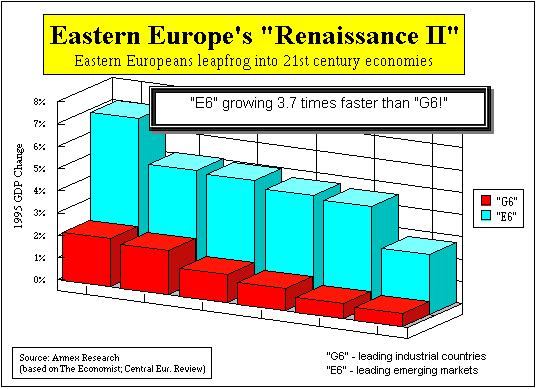
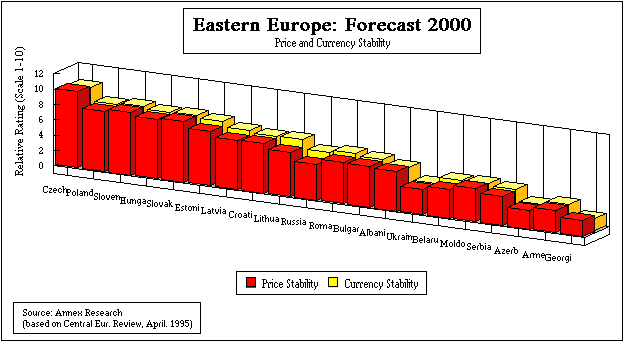
And even a wider average 1996 GDPs of some 20+
countries which comprise this emerging market will be twice as high as
those of the leading industrial economies (3.7% vs. 1.7%).
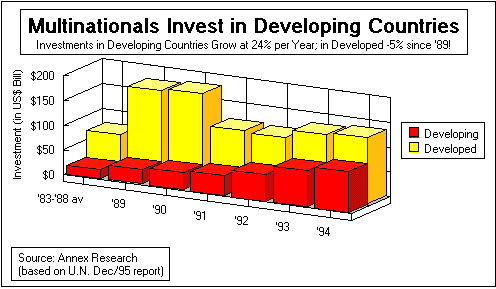
No wonder that Eastern Europe had attracted $19 billion of
private multinational companies’ investments between 1990 and 1994,
according to the United Nations’ 1995 “World Investment Report.”
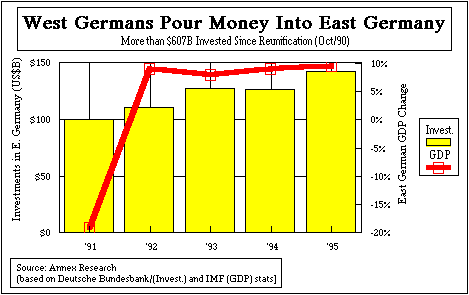
But that was only a modest start, especially compared to the $607
billion which Germany has invested in East Germany since 1990[1],
or considering what we saw during our May 1996 whirlwind tour of Central
and Eastern Europe.
|
|
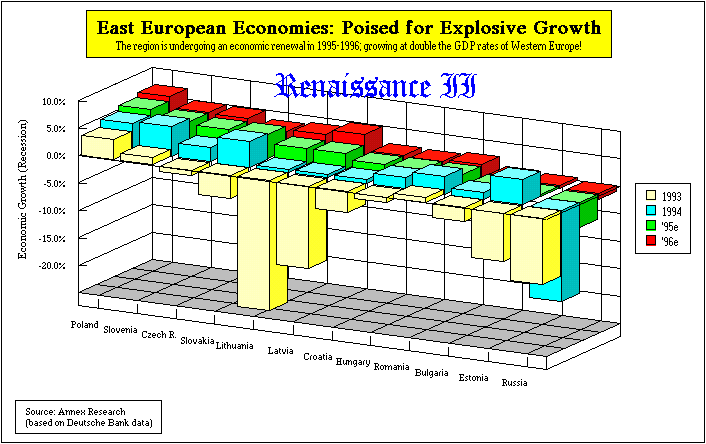
Money is only now also starting to pour into the
other formerly Soviet-dominated countries.
Heavy investments are being made in the building of the
infrastructure necessary to support the 21st century-style
information-based economies. These
investments won’t show up on the charts until about two years from
now, when the U.N. releases its 1996 investment report.
But there is no doubt that a sense of optimism and vibrancy is in
the air everywhere. Long
depressed by the Soviet communist boot, Eastern Europe is quickly
becoming one of the world’s hottest markets.
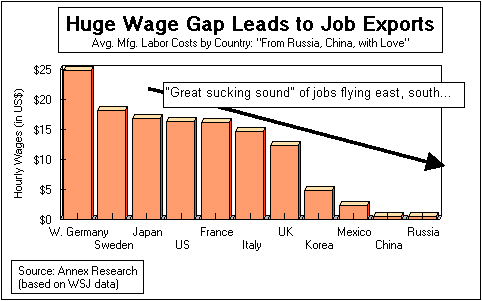
Its cheap labor has always been an attraction for industrialists
eager to reduce production costs. Its
highly educated work force has always been an allure for high-tech
firms. But now, Eastern
European economies are also starting to grow.
After shrinking 5.4% in 1993 and showing only a modest growth in
1994 (up 1.2%), the average growth doubled in 1995 (to 2.4%), according
to Deutsche Bank.
And we figure it will increase by 3.7% in 1996.
“The Nordic firms have discovered a Taiwan next
door,” said Jorgen Dan Jensen, deputy managing director of Denmark’s Investment
Fund for Central and Eastern Europe, according to the Central
European Economic Review (Nov. 1995), a Dow Jones publication.
Denmark’s five million people, for example, traded as much with
Eastern European countries in 1994 (about $658 million) as did France, a
country with 57 million people.
But
the “New World” which the “Vikings” discovered without having to
cross the Atlantic, is no longer just theirs for the taking.
We’ve seen many British and German firms, as well as some U.S.
multinationals moving into this emerging market, trailing the funds made
available by the IMF, the World Bank or the European
Bank for Reconstruction and Development.
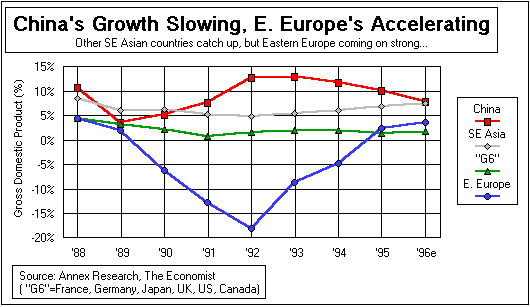
Some of these multinationals are diversifying their investments
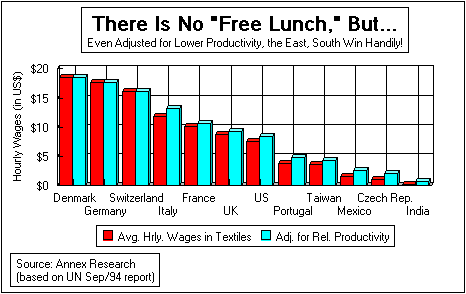
away from China, whose growth has started to slow (see the chart), not
to mention the increased political instability in that part of the
world.
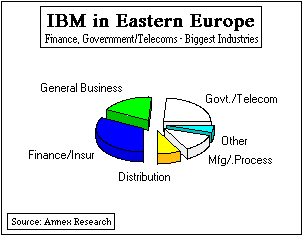
Banks, Telecoms,
Governments - Top IT Users. Where are most of the IT
investments being made? In
the banks and telecoms, it seems, which are growing by leaps and bounds.
Also, the various other government-run programs (e.g., pension
and insurance funds, medical and social security systems, etc.).
Primed for
Servers. In
its initial recovery phase, the Eastern European customers bought a lot
of PCs - as a “quick fix” to their IT problems.
Even today, the PCs account for more than 50% of customer
spending on computer hardware in some countries (e.g., Czech Republic,
Poland, Russia...). These people bought the PCs because they were cheap and
because their telecommunications structure was inadequate.
|
“Yanks” in Poland |
Now, not only has the latter improved considerably in
most countries (massive investments have been made in the
telecommunications area during the last five years - the biggest
surprise for us during this research trip), but the PC buying frenzy has
created a large “client” base for the more powerful “servers.”
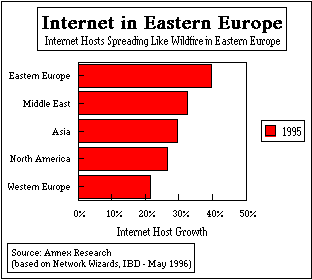
Add to it an explosive growth of Internet hosts, in
which Eastern Europe leads the world, according to Network Wizards, and you’ll see why this market is now
“primed” for vendors with premier server offerings.
IBM is well positioned to take advantage of this
opportunity with its four server platforms - the S/390, the AS/400, the
RS/6000 and the PC. But it
must move quickly and aggressively, as its competitors, especially HP
and Microsoft NT, have already staked out strong positions in the
biggest markets (e.g., Czech Republic, Russia).
Nor are these two vendors the only ones.
We’ve also seen DEC, Compaq and UNISYS, for example, actively
pursuing this huge opportunity.
|
|
IT Market.
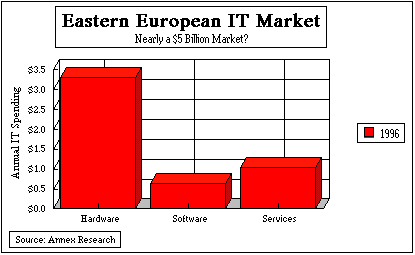
The overall IT market in Eastern Europe is growing by leaps and bounds.
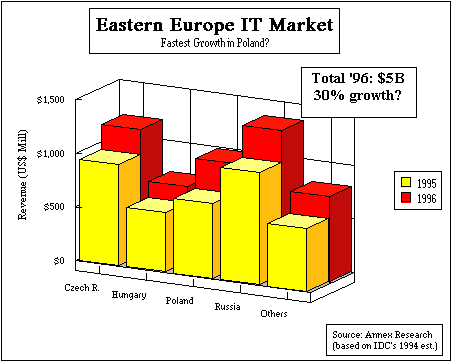
In 1994, IDC estimated the Eastern European annual IT spending to
be about $3 billion, and growing at 25% to 30% per year. This would make it about a $5 billion IT market in 1996.
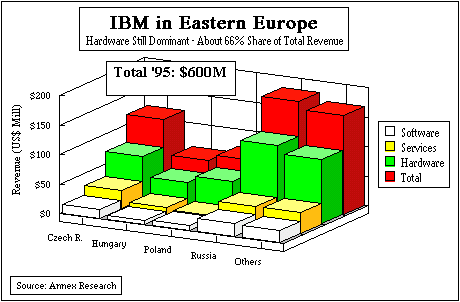
Of the above total, we figure that about 66% is being
spent on hardware, a much higher total than in the developed countries,
where the hardware spending is typically less than 50%.
The customers we’ve talked to spend about 21% of their IT
budgets on services, and about 13% on software.
This means that the Eastern Europe 1996 hardware, services and
software markets are about $3.3 billion, $1 billion and $650 million
respectively.
Practically
Unlimited Opportunities.
Given the significant investments being made in the development of the
IT infrastructure, and the rapid growth of this IT market, it seems that
the degree of a vendor’s success in Eastern Europe is only limited by
its investments and its marketing commitment.
Asked what the biggest challenge for IBM in this part of the
world is, Horst
Breitenstein, the Vienna-based head of IBM
Central and Eastern Europe, replied that it is the relative absence
of leading Western business partners.
This view was echoed in our discussions with some local business
partners. For the most
part, they lamented the low penetration of the “big names” among the
independent software vendors (ISVs).
Fragmented
Market.
One reason for that is, of course, that Eastern Europe is a fragmented
market, and Western applications have to be customized for the
customers. Not only does
the software have to be translated into more than 20 local languages,
but some of them even use a different alphabet (Cyrillic - Russia,
Belorus, Ukraine, Bulgaria, Serbia...).
Furthermore, there are many cultural and regulatory
differences even between similar countries (e.g., the Czech Republic and
Slovakia, or Slovenia and Croatia, both sets of which, until very
recently, were a part of Czechoslovakia and Yugoslavia respectively).
No matter how small their country, the Eastern Europeans thrive
on being “special.” The
vendors who are not prepared to treat them as such will face significant
roadblocks on the way to success.
All this requires subtlety, understanding, patience
and long-term financial commitment by the Western ISVs.
Even more importantly, however, it requires a desire
by the “big name” firms to build long-term relationships with the
local IT business partners, without whose talents and efforts the
success of a foreign company is rather questionable.
Fear of Unknown.
One reason for the relative absence of the “big name” firms from one
of the world’s hottest markets is fear of the unknown.
Fear of the unknown is understandable and natural to human
beings. For companies whose
base may be in Arkansas, Iowa or Oklahoma, to mention some “middle
America” states, it can be pretty intimidating to contemplate
investing in a foreign market whose languages you don’t understand,
and which had been labeled for decades as an
off-limits-for-most-Westerners region - the dreaded “behind the Iron
Curtain” world.
But such fears can be eased by a simple visit to some
the Eastern European countries. Most
American business people would be amazed how “American” these
countries have become, while managing to maintain their own cultural
uniqueness. And not just by
the presence of the symbols of the American retail culture - Coke,
Pepsi, McDonald’s, Pizza Hut... Or
by having Cindy Crawford smile at you from hundreds of billboards.
The U.S. business travelers may be pleasantly surprised by the
availability of American telephone jacks and electrical adapters.
Over the last decade of researching the global IT
markets while traveling with a laptop, we have gotten used to having to
travel through Western Europe with an accessories kit which grew to be
bigger than the laptop itself. Naturally,
we expected to add to our collection of petty national differences on
this trip to Easter Europe! Well,
we were wrong. Hotels, IBM,
customer and business partner offices were all equipped with
American-style jacks and sockets. Eastern
Europe’s original curse - a lack of a telecommunications
infrastructure - has now turned into an advantage over Western Europe,
which has to bring forward the legacy of its older systems, any time it
contemplates an upgrade. It’s
kind of like being able to start with the PC and Windows software,
without having to worry about what to do with your existing mainframe
investments.
Youth at Helm. American
business visitors to Eastern Europe may also get energized by seeing so
many young people in positions of authority and responsibility.
IT is a young industry globally, but in Eastern Europe it’s a
relative infant compared to the developed Western countries. Nowhere else in our travels around the world have we seen so
many “MTV generation” members running their country’s IT centers
in banks, governments or insurance companies, or developing solutions
for IT vendors, such as IBM or its partners.
These young people are Eastern Europe’s real
business treasure. They
guarantee the long-term returns on one’s investment.
If treated right (i.e., if given freedom to experiment and fail),
we’ve seen them work their hearts out without
regard for
“normal” working hours, employment benefits, or negativism which
characterizes the expensive, yet spoiled, labor forces in some developed
countries.
Market and
Education. A strong antidote for fear of the unknown is - greed.
Once the leading ISVs realize the tremendous business
opportunities which the Eastern European markets offer, exemplified by
the explosive revenue growth of an IBM Hungarian business partner (shown
above), chances are they will overcome their parochial inhibitions.
But first they have to get educated.
This is where the hardware vendors can help themselves and the
ISVs, too. The
observations, analysis and conclusions such as those in this report, for
example, are not necessarily intuitively obvious.
They will possibly come as a revelation to many ISVs.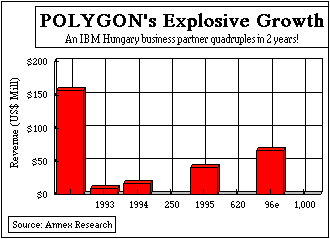
In addition, the hardware vendors can help themselves
by playing the role of matchmakers - between the Western ISVs and the
local partners. Being a
good matchmaker in business is no trivial task.
It takes diligence, patience, but above all - investment!
Customize,
Don’t Standardize Marketing. Last but not least, the IT
vendors must invest in image building, both for their companies and for
their products. Once again,
this takes patience, diligence, but above all - investment!
One must not assume that just because a company or a product is
household name in the West, that the same is true in Eastern Europe.
Western Gaffes.
Possibly the worst mistake a foreign vendor can make in Eastern Europe
is to simply take its Western marketing and advertising campaigns and
translate them into local languages.
Sometimes, comical reactions can result with tragic business
consequences.
·When
Ralston Purina used the image of a bunny for its Eveready
Energizer batteries’ ads in Hungary, the local customers thought
the company was selling toy rabbits, not batteries!
·When
a U.S. baby care company advertised bath soap, it showed a young woman
holding her baby. But the
ad scandalized Hungarians who saw an unwed mother.
The model was wearing a ring on her left hand.
Eastern Europeans wear their wedding rings on their right. “And then Western marketers wonder why people here won’t
buy their products?,” a Hungarian ad executive said to the Wall Street Journal, seemingly reveling in the ignorance of
Americans.
·Closer
to home (i.e., the IT market), one IBM executive told us that his
company insisted on conformity of corporate and products’ image.
Armonk insisted on running the “standard” IBM corporate ads
in the Russian market. The
ads were simply translated into Russian.
But the translation was so bad, that the confused Russian
customers didn’t know if they should laugh or just ignore the ad.
Fortunately, one of them thought well enough of IBM to point out
the ad’s ludicrousness to this non-Russian speaking Western executive.
Reverse Gaffes.
Sometimes, the cultural differences can be comical in reverse, too.
·A
senior diplomat at the U.S. Embassy in Belgrade, Yugoslavia, for
example, showed us an ad by a local company which sells mobile
telephones and provides Internet access.
“They could use a new PR firm,” the diplomat suggested with a
chuckle.
The name of the firm?
MOBTEL!
In the local language, the name is quite innocuous.
But to an English-speaking person, it may connote doing business
with the mob.
·“Oh,
that’s nothing,” commented the publisher of a leading Belgrade
newspaper, with whom we shared the MOBTEL laugh.
“There was once a Macedonian confectionery firm whose name was
S.H.I.T.”
And in the Albanian language, the same word, minus
the periods between the letters, apparently means “(for) sale,” and
thus can be often seen in store windows.
·Similar
to the IBM gaffe in Russia, Coca-Cola launched a multi-million campaign
in China, whose proud slogan was: “Bite the wax tadpole!” - the
English translation of what the native Chinese thought the Coca-Cola
company was telling them.
·An
Italian gynecologist advertised his practice as: “A specialist in
women and other diseases.”
·A
Romanian tailor had the following English-language sign posted for his
overseas customers: “Drop your trousers here for best results.
Ladies may have a fit upstairs.”
·“Don’t
enter a woman if dressed as a man,” an Eastern European hotel restroom
sign warned.
Whoever said that international marketing was easy...
r
|
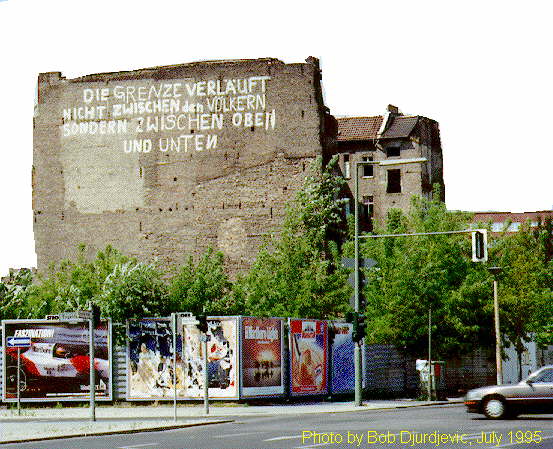
An East Berlin Sign: “The border runs not between the peoples,
|
2. IBM in
Eastern Europe: An Incumbent Facing a New Frontier
IBM
SUBSIDIARIES:
Hungary
Since 1936
Poland
Since 1991
Czech Republic
Since 1992
Slovakia Since 1992
Slovenia Since 1992
Russia
Since 1993
Bulgaria
Since 1994
Romania
Since 1995
Croatia
Since 1995
Deep Roots.
Even
before it was “kosher” to do business in Eastern Europe, IBM was
there. It was in Hungary in
1936, when Tom Watson, Sr., was still the company’s CEO.
It was in the U.S.S.R. in the 1970s, during a brief thaw in the
Cold War. It was in the
former Yugoslavia in the early 1960s when Marshall Tito was still the
boss. It was there when the
Soviets modeled their own mainframe technology after the IBM S/360s, and
when they smuggled IBM PCs behind the “Iron Curtain.”
IBM was the incumbent vendor even before it (re)opened its
offices in Eastern Europe. And
IBM was among the first to return when Eastern Europeans’ “Velvet
Revolutions,” and the guns of Bucharest, tore down the “Iron
Curtain.”
|
|
Given its deep roots in this part of the world, you
would think that IBM is by far and away the dominant computer company.
Well, think again...
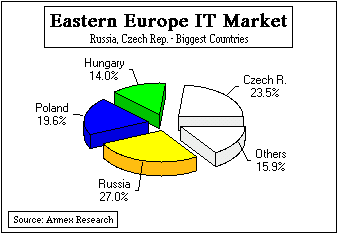
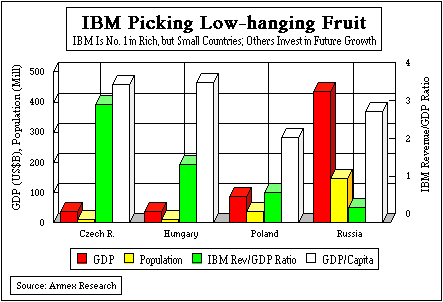
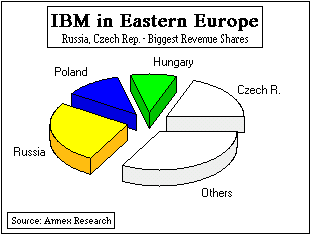
IBM is the No. 2 IT vendor in Russia and Poland
(behind HP) - the largest countries in the region with a combined
population of about 187 million. IBM
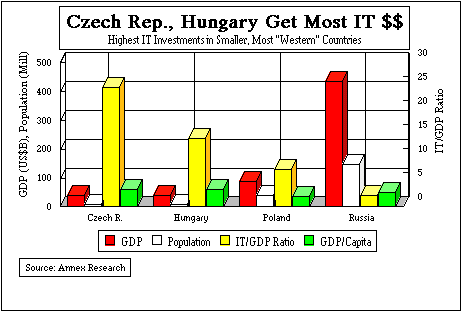
is No. 1 in the Czech Rep. and Hungary - the richest countries in the
area[2],
with a combined population of only 21 million - nine times smaller than
Russia’s and Poland’s. In
addition, Russia and Poland are farther from Vienna and have many
regional centers, while business in the Czech Rep. and Hungary is more
concentrated in the capitals - both only a 40-minute “puddle hopper”
flight away from the headquarters of IBM Eastern Europe.
It may seem perfectly rational, therefore, from the
profitability standpoint, that IBM should be focusing on the latter two
countries. But in emerging
markets, market share has to
rank higher than the bottom line! Emphasizing
the Czech Rep. and Hungary (which received an IBM disk plant investment
- in Székesfehérvár), instead of Russia and Poland, is like stressing
Vermont and New Hampshire while snubbing Texas and California!
The Czech Rep. and Hungary, however, is also where
the money seems to be (IMF, World Bank, EBRD).
Which means that IBM seems to be picking the low-hanging fruit,
instead of developing the bigger, but relatively poorer markets.
Judged by the Western European results, which ranged
from revenue declines to meager growth in the 1990s, IBM Eastern
Europe’s 25% growth looks great by comparison.
But that’s a complacency trap which its executives should
avoid. Their challenge is
not to be lulled by such comparisons.
In addition to picking the low hanging fruit, they should try to
“reach the stars through hardships” - “per
ardua ad astra,” as the Latin proverb suggests, i.e., get more
aggressive in Poland and Russia.
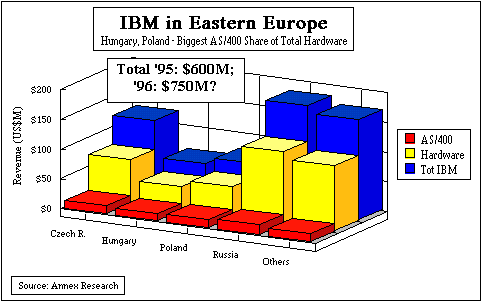
Good 1995/1996
Results. We
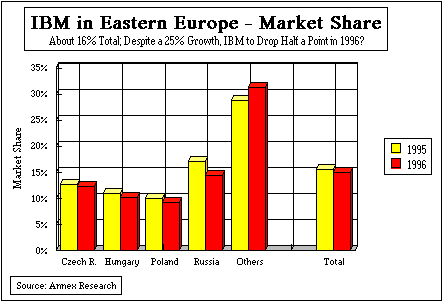
figure that IBM’s Central and Eastern European 1995 revenues were
about $600 million. That’s
about 16% of the total market, but less than one percent of the
company’s worldwide 1995 revenues.
In 1996, even if this IBM region manages to grow its revenues by
25% to $750 million, as we suspect it will, the “Big
Blue” will still fall behind its competitors, as we expect the
market to grow by 30% to about $5 billion (based on IDC’s 1994
forecast).
There is a race for the IT supremacy in Eastern
Europe in which “no prisoners are taken.”
Companies with great past track records, such as IBM’s, could
still end up as respectable “also rans” in this fast moving market.
Especially if its top executives have their eyes on China and
Southeast Asia, while competitors pick their pockets in the potentially
more profitable Eastern Europe. An
incumbent vendor’s success in this emerging market is only limited by
its own imagination; its understanding of it, or commitment to it.
No Pain, No
Gain. As did the explorers of new Western frontiers a hundred or
more years ago - the American pioneers who crossed the Mississippi, or
the Rio Grande in their quest for riches - today’s multinational
companies must live and die by their swords in “emerging markets.”
And, as did the pioneers of the American frontier,
sometimes the multinationals will also fall on their swords.
Seasoned bureaucrats in the developed industrial countries, who
try to play the roles of explorers of the world’s “emerging
markets,” are particularly prone to the latter predicament.
For, they have all the “wrong” kinds of experiences, and none
of the “right” kinds of intuitions.
IBM will succeed in Eastern Europe if it relinquishes
its corporate hold on decisions which its local entrepreneurs can make,
and challenges them to deliver the value for the money they invest.
If Armonk fails to realize that, well... stand by for a 16%
market share to drop to... pick a lower percentage. r
IBM in
Eastern Europe:
Armonk:
Tight with Money Bag?

IBM
SUPPORT CENTERS:
Systems Support Center
Ljubljana, Slovenia
Language Support Center
Budapest, Hungary
Industry Support Center
Vienna + Kiev, Ukraine
Education Center
Bled, Slovenia
Banking Competence Center
Ljubljana,
Slovenia
CATIA Center
Bratislava, Slovakia
Open Systems Center
Prague, Czech Rep.
Application Support Center
Moscow, Russia
3. IBM AS/400 in
Eastern Europe
AS/400 Eastern Europe
- Born in 1988
- Reborn in 1989
- Rose to fame in 1989
- Matured in 1990-1993
- Hurt by “open systems”
- Hurt by inflated expectations
trend in
1990
in 1990-1992
- Rebounded 1991
- Struggling to find own identity
- Slowed by Euro. slump
in 1992-1993
and IBM in 1992-1993
- Rebounded in 1994-1995
- Rebounded in 1994-1995
- Poised for solid growth
- Poised for solid growth
in 1996 and beyond
in 1996 and beyond
AS/400 - the Birth.
It
was the time of glasnost (“glasnost”= openness) and perestroyka (“perestroika”= restructuring) in the
former Soviet Union. But
also that of Cold War. It
was the time IBM was talking openness, but delivering proprietary
systems. It was the era the
Big Blue still looked big and
invincible almost everywhere except in its mid-section, where DEC seemed
omnipotent. It was the year
after IBM’s “year of the customer” (1987), which gave competitors
a chance to boast that “every year is the year of the customer” if
you don’t do business with IBM. It
was the time of the Seoul Olympics and that of soul searching; the last
of Reagan’s presidency. It
was the year before the Berlin wall came down, ushering new hope and joy
in Eastern Europe. It was the year before freedom was reinvented...
|
|
It
was in such a time that a new baby was born on June 21, 1988 in the IBM
Rochester manger. “Silverlake[3]”,
as the expectant parents referred to the growing embryo during the early
months of the two-year gestation period - a record low by the then IT
industry standards - was christened “AS/400” at an extravaganza
announcement held in New York, and beamed around the world via satellite
TV - the first time thousands of IBM customers, business partners and
employees witnessed a live birth of a computer baby.
A “Blue Ribbon” Server

“The way we put it together
Bob Dies, GM, IBM AS/400 Division
“IBM
will probably be very successful with the new AS/400 products,” we
wrote in a report published the day the AS/400 was born.
And it was...
As
it turned out, the AS/400’s birth was IBM’s best launch in almost a
quarter century (since the birth of the S/360 in 1964).
Since
then, the AS/400 launch has become a model for most subsequent major IBM
announcements. More
importantly, the product has become a model for all IBM platforms.
Not just because of its integration philosophy; not just because
of its industry orientation; not just because it has circled the globe
like a “peace dove,” wooing more than 400,000 customers; not just
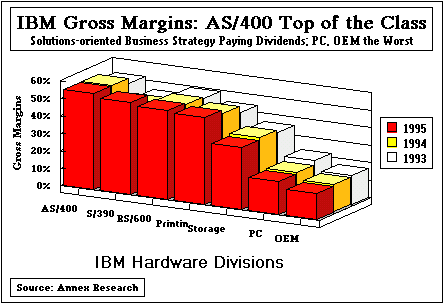
because it has become IBM’s most profitable system...
But because the AS/400 team has achieved all of the above in the
face of adversity, both in the 1989-1990 and the 1992-1993 periods. Just like Eastern Europe...
The
second biggest hurdle to a faster IBM business growth is a lack of
Western business partners in this emerging market.
That’s especially discernible in the AS/400
business, whose “bread and butter” are the independent business
partners. To be sure,
you’ll find some of the Western companies represented mostly through
agency agreements with local service or software providers in some
Eastern European countries (e.g., JBA, Fiserv, J.D. Edwards, Ibis,
Midas, etc.). But as we
pointed out in the first section of this report, that’s only a token
presence which is merely scratching the surface of market opportunities.
|
AS/400: A Global IT “Peace Dove?”
Big
in North America,
|

Huge Installed Base. Over 10
years ago, Dick Williams, at the time an IBM mainframe marketing
executive, told us perhaps a bit facetiously that, "UNIX has some
nice characteristics. The
most significant of them being a large number of users."
The UNIX market which drew such accolades from IBM's high-end systems
people numbered only 100,000 users at the time.
In the years that followed, and especially after the AS/400 announcement in 1988, and its four major subsequent product line facelifts, IBM's combined AS/400 and the S/3X worldwide installed based has grown to nearly half a million units. And some of these customers have actually switched from their UNIX applications to take advantage of the AS/400’s simplicity and power. That means several million people who do actual or potential reference-selling for the AS/400. Coupled with aggressive advertising and merchandising by IBM, all these items could add up to significant marketing assets for IBM and its midrange partners.
No wonder that the AS/400 is today by
far the world's best
recognized name in the midrange computer market.
Its unaided advertising awareness exceeds
that of any other IBM or competitive midrange system.
This means that the AS/400 software developers, distributors
and other services suppliers have the market
momentum working for them. No
wonder the AS/400 now boasts over 20,000 applications developed by
about 8,000 providers.
Happy Customers. One of the reasons the AS/400 has been so successful is that this IBM Division never took its customers for granted; it never developed the "commodity" mentality which became prevalent in so many other IBM segments. As a result, since the majority of its systems are sold outright, it would have been easy to fall into the commoditization trap. But the AS/400 people continued to treat their customers as if the machines were on a month-to-month rent, meaning the customer could have thrown them out at any time. Such attitude has consistently earned the AS/400 the world's highest customer satisfaction ratings and loyalty.
|
|
Happy Employees. The
attitude of not resting on its laurels and having to earn its stripes
all over again every year, also earned the AS/400 Rochester lab and
factory the U.S. government's coveted Baldridge Award in December
1990 for manufacturing and development excellence.
And the various trade and business media continue to give the
AS/400 people recognition awards, such as the "product of the
year," for example.
Low Cost. It didn't hurt the
AS/400's popularity with customers that the product continues to deliver
the industry lowest overall cost
of computing. We figure
that the product has been on a 40%+ price-performance curve ever since its
introduction in 1988. But
the customers' greatest savings come from the low cost of maintenance
of its applications as compared to other computer platforms. “The AS/400 is the least expensive environment because of
its integrated functionality,” stated a recent (1996) study by IDC.
IDC said that the AS/400 delivered the lowest total cost per
workstation compared to UNIX, Novell NetWare
and Microsoft NT solutions.
Happy Chairman. But the AS/400 received perhaps its greatest endorsement
when IBM's new chairman and CEO, Louis
V. Gerstner, and a former large
IBM customer (at American Express and RJR Nabisco), threw out the old
office systems, "which were not quite into the 1990's", and
installed the AS/400 as his system of choice for the company's world
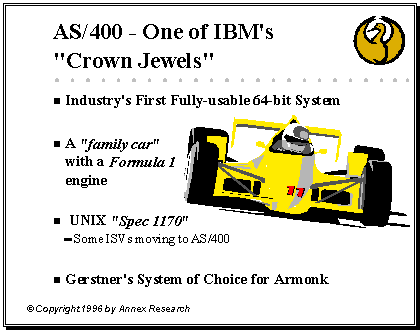
headquarters in Armonk, New York. In a speech to a group of IBM business partners, Gerstner described
the AS/400 as "the most successful computer system ever introduced
to the world." He
attributed its success to its low cost and ease of use.
Gerstner compared other systems (e.g., UNIX) to the "Formula
1" racing cars - a sport he said he knew quite well from a supplier
standpoint. They can go
very fast, but "they also burn two engines a weekend.
That's $500,000 per weekend per car," he said.
And if you ever drove one of those cars from Rochester to Minneapolis,
he speculated that the car would "probably break down," and
the driver "would probably get thrown out of the car."
By
contrast, Gerstner likened the AS/400 to a "family car." As a customer, he said he could not care less about technology
- the "bits and bytes." He
cared about "solutions," he said.
"The AS/400 is the best 'solution computer' in the
world," Gerstner opined. Which
is why "we are going to continue to support it."
Happy Business Partners. The AS/400 Division would not have been able to generate
such impressive results for IBM had it also enabled the thousands of its
business partners to generate wealth for themselves.
As Gerstner told his Rochester audience, partnerships can only
work if both parties win,
i.e., make money. For every
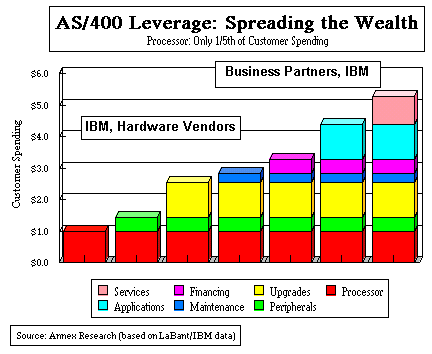
$1.00 of processor hardware which IBM sells, the AS/400 system generates
$4.30 of additional wealth
for someone (see the chart on next page).
And more than half of that additional business "drag"
is available to independent providers of application software, maintenance,
financing and other service companies.
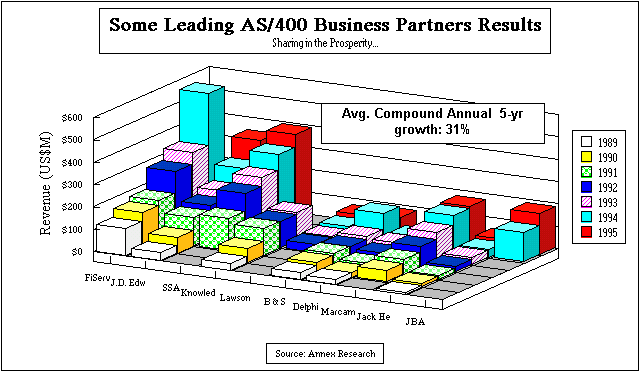
No wonder so many business entrepreurs have flocked to the AS/400
(more on the business partners’ results on the next page).
“It is the only surviving proprietary system on the market
today, because IBM made it open,” said Ed McVaney, of J.D. Edwards, a Colorado
software vendor. “It’s
an incredible comeback story.”
UNIX Software Cos. Turning to AS/400.
Rainier
Zinow, of German-based SAP AG, until recently a predominantly UNIX software company,
said that SAP has joined the AS/400 program “because our customer base
communicated to us that they would like to see (the) R3 running on the
AS/400.” PeopleSoft, another UNIX
software vendor, said they turned to the AS/400 for the same reason - to
meet their customers’ demand.
Best 64-bit PC Server? Nor is the AS/400’s simplicity appealing merely to UNIX
customers or ISVs. As we
pointed out earlier in this report, nearly a quarter of the new AS/400
sales are coming from the PC LAN base.
This percentage is likely to grow as an increasing number of PC
users begin to realize that the conversion from the 16-bit DOS
or Windows 3.1 applications to
the 32-bit Windows NT or Windows ‘95 world will be no piece of cake.
“We
found the (Windows NT)
learning curve is steeper
than one would have thought,” said Arthur Tisi, CIO at New York’s
Metropolitan Museum, according to an Information
Week story. “Microsoft
said we could have it up and running in 20 minutes.
That’s a fallacy; it’s not realistic.”
Some
corporate PC customers also told the Information
Week that hidden training, migration and support costs related to Windows ‘95 or Windows NT
are rarely mentioned. Or
the fact that the “NT appeal will be limited because it can’t run
many legacy DOS and Windows applications, and because it lacks support for a long list
of device drivers.”
All
of which only leaves the door ajar for a proven 64-bit system (the
AS/400) in accounts where the facts, rather than the hype, matter more.
r
To
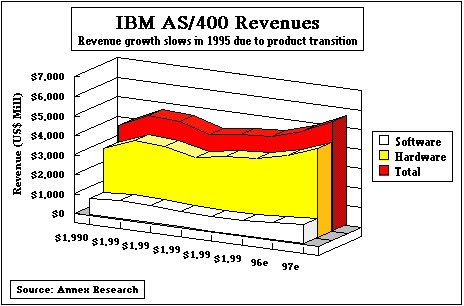
IBM Business Partners, the AS/400 Means Sharing in Growth and Prosperity
4.1 Spotlight
 on...
on...
Hungary

A relatively small country (10.4 million population,
61% urban) with a relatively high income for Eastern Europe ($3,700
GDP/capita), Hungary is rapidly industrializing

Land of “Goulash Communism.”
Even before the rest of Eastern Europeans dared think
about throwing off the Soviet yoke, Hungary was regarded in the West as
the land of “goulash communism.”
The implication? Putting
food on the table, even if the capitalist-style, was more important to
Hungarians than adhering literally to the communist dogma.
The country was also the most open of the Warsaw Pact states,
which is why it served as an escape route to the West by many Czechs,
Poles or East Germans. In
the IT industry, well before the Berlin Wall came down, Hungarian
companies and individuals were producing the software designed for
Western markets (e.g., for some Israeli companies).
Given all that, one would think that Hungary is light years ahead
of other Eastern European countries.
Well, think again...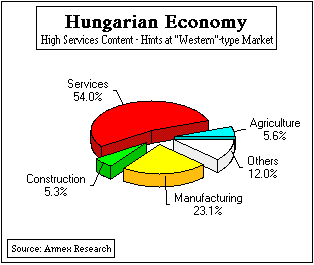
To be sure, Hungary’s $3,700 per capita Gross
National Product (GNP) is the highest in Eastern Europe.
And the country has attracted more investments by multinational
companies than any other in the region ($6.8 billion between 1990 and
1994, versus only $2.3 billion for Russia, for example, a country 14
times bigger!).
But Hungary’s economy has sputtered in 1994-1995,
with its GNP rising only about 2%, while its neighbors grew at much
higher rates (e.g., Czech Republic).
Its inflation has remained relatively high (19% to 20%), double
that of the Czech Rep., for example.
And Hungary’s unemployment of 10% to 11% is three to four times
that of its neighbor to the north (Czech Rep.).
Budapest - Center of Hungary’s Business World.
“About
20% of Hungary’s population is based in the Budapest area, and about
80% of the country’s business,” said Zsolt
Veres, the country sales manager for IBM, an energetic young
executive who speaks excellent English and epitomizes the
“go-getter” attitudes of the new Eastern European breed of business
people.
As
we’ve noted in section three of this report, such a high concentration
of business in the capital city makes it easier for IT companies to sell
their products. But the
fresh paint and a new look of many retail establishments in the
Hungarian countryside also serve to remind the visitors that 39% of
Hungary’s population live in the rural areas.
Best AS/400 Country.
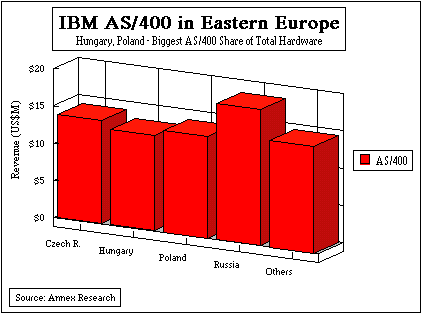
In terms of the AS/400’s share of the total
hardware business, Hungary is IBM’s best “AS/400 country” in
Eastern Europe. The
maturity of Hungarian customers is also reflected in the lowest share of
PC business of any other country in this region which we have visited.
The main reason for that is the availability of the top-notch
AS/400 applications and the system’s ease of use.
But alas, IBM Hungary, as some the other IBM
operations in Eastern Europe could use a little more support from the
base - Armonk, that is. For,
although six U.S. multinationals[4]
are among the top 10 investors in Hungary during 1990-1993, IBM, a
company which has had an active subsidiary there since 1936 - was not
one of them. Since that time, however, IBM did invest in a storage
products plant (see page 19).
Still, the combined investments of the U.S.
multinationals in Hungary during 1995 represented less than a third of
that which even the companies from a tiny Austria have made!
German, Dutch, British and French companies have also invested in
Hungary more than the U.S. Do Americans know something the Europeans don’t?
We doubt it. It is more likely that they are more ignorant about this
market.
POLYGON.
In
the first section of this report, we’ve already showed you a chart
depicting a phenomenal growth of Polygon,
one of IBM’s Hungarian business partners, which quadrupled its
revenues in just two years (between 1993 and 1995).
Gál György, a company director and one of the six
owner-managers in the firm, told us at his Budapest office that his
company had become an unwitting systems integrator for IBM. “We simply responded to what our customers were asking,”
he said, sounding almost apologetic that a greater “vision
statement” wasn’t at work here.
Polygon,
which started as a maintenance service company, has sold some $2
million-worth of AS/400s in 1995, by merely “responding” to the
customer demand, as György said.
They also shipped about $1 million-worth of IBM PCs, and
almost $700,000-worth of the RS/6000s - all on an agent-basis.
In addition, Polygon is
an “IBM cabling partner,” and a “networking partner,” the
company brochure states. And it represents Arkansas
Systems (an American ISV) in Hungary.
In other words, its shade of “blue” is only a tad
lighter than that of the Big Blue
logo. But Polygon’s belief that the AS/400 is the best solution for the
Hungarian market is possibly even stronger than IBM’s.
“In two year’s time,” György predicted, “I
am convinced that the AS/400 will have an AIX (i.e., UNIX) card, but not
the other way around.” 1In
other words, he thinks it is more likely that the AS/400 will attract
the UNIX aficionados than the other way around.
Inter-Europa Bank. Such
feelings were shared by the top IT managers of Inter-Europa
Bank, including Tamás Foltányi, the executive director, with whom we met at
the bank’s posh and newly renovated headquarters in downtown Budapest
- kitty-corner from the ornate U.S. Embassy and the main Hungarian TV
buildings. The bank, which
is 27% owned by San Paolo Bank
of Torino, Italy, and whose net profit jumped by 42% in 1994, has four
AS/400 systems installed. One
of them is the IBM top-of-the-line
530 model, on which the bank plans to test SAP’s popular “R3”
software. The bank has 30
IT people, 40% of whom support the AS/400, while some 60% work on its Midas
application software. r
4.2 Spotlight
on...
Czech
Republic
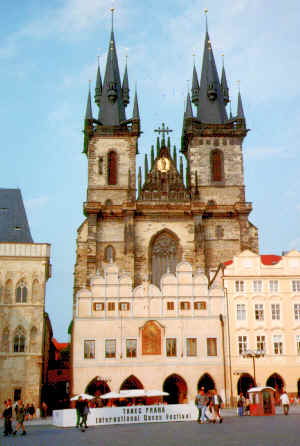
A 1995 photo by Tanja
Anne Djurdjevic
Another relatively small country (10.4 million
population, 77% urban) with a relatively high income ($3,600
GDP/capita), the Czech Republic has become the darling of Western
investors; how long will the party last?

Land of the “Velvet Revolution.” While other Eastern Europeans shot or shoved their way out of the Soviet domination, the Czechs shouted themselves into a “velvet revolution.” In the end, their home grown communists left office quietly, tail between their legs, as the former dissident-playwright, Vaclav Havel, became the new president. “A trip from the jail to the throne,” is how one Eastern European writer described his colleague’s rise to power in 1990. Six years later, the Czech Republic, the Western part of the country the world once knew as Czechoslovakia (before the 1990s), has become the new darling of tourists as well as Western investors in Eastern Europe.
Having
invested heavily into the (re)building of the business infrastructure,
especially that of its banking and telecommunications systems, some
Western economists think that the country has already achieved what it
takes to qualify for a full membership in the European Union.
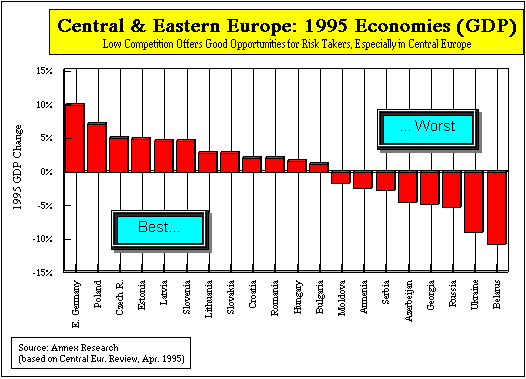
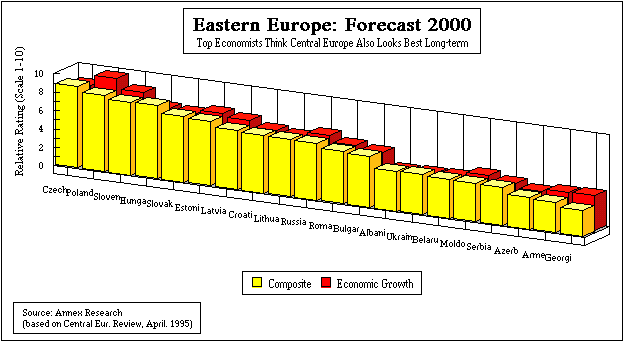
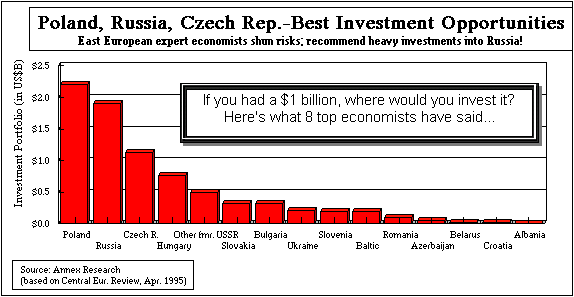
Six of the eight economists interviewed by the Central European Review in April 1995, said they would invest
between 10% and 25% of their total Eastern European funds into this tiny
country. The economists
from Deutche Bank (Germany) and Creditanstalt
(Austria) led the way by earmarking 30% and 25% respectively of their
investment portfolio for this purpose.
From Boardrooms
to Scaffolds.
And invested they have... Prague,
one of the most beautiful cities in Europe even before its
“Renaissance II,” is almost literally being rebuilt while preserving
its old charm. Even before
the main summer tourist season began, one could see hordes of tourists
speaking scores of foreign languages in its streets. About the only negative comment about Prague we heard came
from a young American student - that there were “too many Americans
here.” It’s unlikely
that the city’s hoteliers, bankers or shopkeepers would complain about
something like that.
IBM in Czech
Rep. IBM
formally joined the “velvet revolution” in 1992, when its
subsidiary, IBM ^eská
republika,
was formed. To overcome the
handicap of a deficient local telecom structure, IBM invested early on
in installing equipment on the existing TV relays with which to deliver
its Global Network. Such
foresight paid off. Today,
IBM services revenue in this country accounts for about a quarter of the
total, partly because of this.
Although IBM ^eská republika
is second only to Russia in terms of its total
revenue, its performance exemplifies what we called “picking of the
low hanging fruit” in the section two of this report.
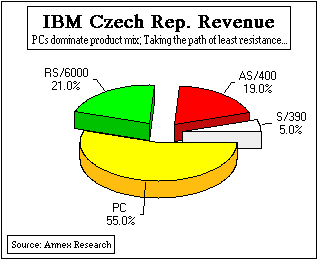
Instead of marketing aggressively its higher value
integrated solutions, such as the AS/400, for example, IBM in the Czech
Rep. has been basically taking orders.
And since the slick marketing by Microsoft
and HP has made the PCs and
UNIX be perceived as “cool” by customers, about 55% of the total IBM ^eská republika hardware revenues were generated by the low-margin PC products.
IBM’s most profitable AS/400 and S/390 platforms, accounted for
only 22% and 5% respectively of the company’s 1995 hardware revenues.
Worse than that is the trend.
Both high-margin products’ shares have declined from the year
before.
|
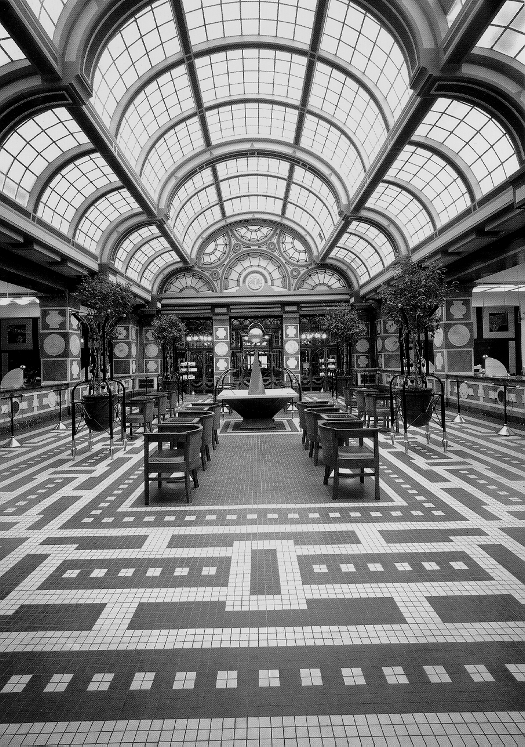
Hall of ^SOB’s main branch in Prague |
"HP had a longer-term view of the market," said Lumir
Srch, president of ITS,
a.s., an IBM AS/400 business partner, who has stuck with the Big Blue through thick and thin.
“They made a massive investment into the future.”
Meanwhile, Karel
Petrzela, a top IBM ^eská
republika
marketing executive, seemed merely content to acknowledge that, from an
image standpoint, “DEC’s Alpha is known in the Czech Republic for
its speed; HP for its UNIX
peformance, while IBM is perceived as a mainframe
company.”
Ceskoslovenská
Obchodní Banka (CSOB).
After hearing an IBM executive make such a statement, it was quite
refreshing to visit an enthusiastic AS/400 customer.
Pavel Holec, the IT manager for ^SOB, one of the country’s fastest-growing banks. “The AS/400 is quite popular today (as a server),” Holec
said referring to the product’s appeal among his banking colleagues. He attributed this to a trend toward centralization, which
has followed the early phase of IT development in the Czech Republic -
buying of decentralized, stand-alone systems.
And Holec knows what he is talking about first-hand.
“This (his data centers) is something like a user
laboratory,” he said. His
operation runs the Ibis
banking software on a total of 63 AS/400 systems, installed at the
Prague head office as well as in 15 branches across the country. Holec and his team completed the system design and installed
the software and hardware in less than a year since the signing of the
contract in late 1991. The ^SOB bank has invested more than $50 million in IT
since April 1991. Its IT
department now employs some 200 people.
Still, other Czech banks of comparable size, which don’t use
the AS/400, employ “at a minimum twice as many people” in the IT
functions, says Holec. To ^SOB, such savings are one of the key benefits of the AS/400 solution.
Thanks to the advent of Czech telecom systems,
Holec’s next plan is to use his AS/400s in a full client/server mode.
“I used to have to wait a long time for international
connections when I called the Ibis
support in the U.K.,” he said. “Now
I get through in a matter of seconds.
Now, a client/server solution makes sense.”
ITS, a.s..
ITS is an IBM AS/400 business partner which develops and sell
software for international trading companies.
Based in one of the few high-rise office buildings in Prague,
built in the 1960s by the state-owned Czechoslovak trading company, ITS literally enjoys a high level view of the industry and its city.
Srch, the ITS
president whom we had mentioned earlier in this report, said that his
company was successful as an AS/400 marketer “despite IBM.” Back in about 1992, when the “open systems” (i.e., UNIX)
trend swept the country, ITS
was getting vibes from the IBM people which implied that the Big Blue would not be supporting the AS/400 in the long run.
But Srch and his people kept the faith and stuck with their game
plan, convinced that the AS/400’s virtues - as a powerful, yet
easy-to-use integrated business solution - would eventually overcome IBM
^eská
republika’s lack
of marketing commitment to it.
ITS
is still a believer, even though Srch says that IBM continues to lack
good advertising, and is losing market share to HP.
“IBM is still ahead,” Srch said, “but only by two points
now.” Sooner or later, Srch is hoping, such trends may serve as a
wake-up call to IBM management.
Ding-dong, ding-dong... r
Prague:
The Old Town Square
Jan Hus Memorial in Foreground
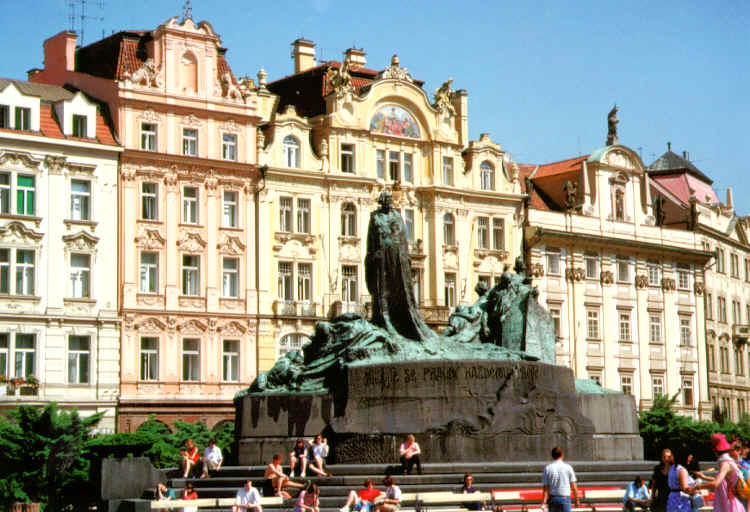
A 1995 photo by Tanja
Anne Djurdjevic
4.3 Spotlight
on...
Poland

Eastern Europe’s second largest country (39 million
population, 62% urban) has been growing the fastest (7% GDP in 1995);
IBM and the AS/400 are both thriving here

Land of “Solidarnosc.” Possibly more than any other country in Eastern
Europe, Poland has contributed to the fall of communism and rise of
market-driven economies. Led
on the ground by a mustached electrician from the Gdansk shipyard, Lech
Walesa, who later became the country’s first elected
president, and inspired spiritually by the first Pole ever to become
Pope (John Paul II), this
staunchly Catholic country became a symbol of resistance to communist
oppression in the early 1980s. A
simple Polish word, "Solidarnos},"
the rallying slogan of the striking Gdansk shipyard workers, became
renowned and admired world-over as a badge of courage.
But real freedoms and financial rewards for the Polish people had
to wait until after 1989, when the Iron Curtain was lifted on Eastern
Europe.
They Saw
the Light First


After several years of struggling to privatize its
industries and businesses, the Polish GDP shot up by 7% in 1995,
according to The Economist,
making Poland by far the hottest economy not just in Eastern Europe, but
in all of Europe, too!
The country is bigger than Italy, and its economy is
much more spread out than it is the case with Hungary or the Czech
Republic - as we’ve noted earlier in this report.
Poland’s heavy industry, for example, is concentrated mostly in
the southern part of the country. Yet
this has not stopped some top economists such as those from Salomon Bros, and J.P. Morgan,
fingering between 40% and 50% of their Eastern European investment
portfolios for this country.
IBM in Poland.
IBM
had a relatively late start in Poland, setting up shop there in October
1991. But IBM had high
expectations for this market right from the start.
“I was given an $X million quota the first year,” recalled Miroslaw Szturmowicz, the
country’s general manager. “By
contrast, HP’s corporate office merely told its Polish manager ‘try
to do the best you can, and we’ll back you all the way’.”
But the difference in corporate styles between IBM
and HP didn’t stop Szturmowicz and his team from achieving enviable
results. Despite the fact
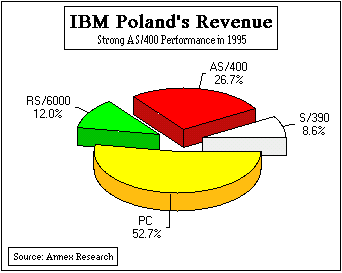
that about 70% of the IT spending in Poland is PC-based, IBM Poland has
managed to build up its AS/400 business to about 27% of the total
hardware.
“There was a myth that you could do everything on
PCs,” said Szturmowicz. So
rather than wait for miracles to happen, he and his team set out to
educate their customers. Lacking
advertising funds, they managed to get the local IT press to write some
articles about the AS/400.
Yet getting the Western business partners interested
hasn’t been a party. Some
have come and gone, lacking a commitment an emerging market requires.
But others who have stayed, also thrived...
JBA.
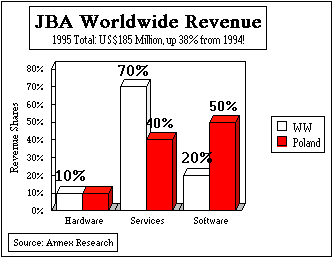
“The
AS/400 is the best option for the Polish market,” said Krzysztof
Abramowski, Poland’s sales manager for JBA,
a U.K.-based global AS/400 ISV, which started its Polish operation in
1993. The sales executive
praised the AS/400’s ease of use.
“You can put it in a room, turn out the lights, and walk
away.”
The implication?
Even if the AS/400 “takes a licking, it keeps on ticking!”
For that reason, “there is a growing awareness of the
AS/400’s virtues,” agreed Marek
Dziduszko, JBA’s marketing
manager in Poland.
Bank Inicjatyw Gospodarczych (BIG). BIG S.A., a publicly-traded Polish bank formed in 1989, epitomizes the
excitement, the energy, the success, the vitality of new Eastern
European businesses. Two
young people, Pawel Pytkowski and Renata
Strauch, both fresh out of college and in their first real jobs,
managed to do in nine months with only four other associates what
usually takes scores of finicky Western programmers to accomplish in
years. They put the BIG Bank in business - the 21st century-style!
Using the Ibis
software now installed on 11 AS/400 systems - at the bank’s Warsaw HQ
as in its eight branches - these
two young executives who share an unpretentious office (their desks face
each other), became Poland’s first Ibis/AS400
customers. “The AS/400 is
a good system,” is all this modest young lady would say, who attended
no courses at all. “The
system’s self-taught menus are very good,” she added.
Strauch has learned all she knows about the AS/400 and the Ibis software by self-instruction!
She and Pytkowski, her nominal “boss,”
who handles the hardware issues while she focuses on software, are a
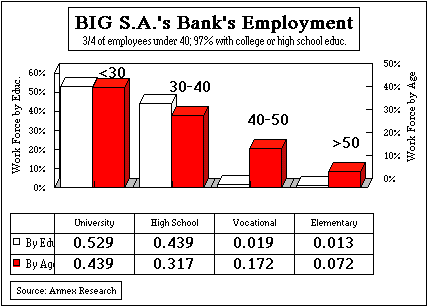
part of a young work force with big responsibilities at the BIG Bank. Over
three-quarters of the bank’s employees are under 40 years of age.
About 97% of them have either a college or a high school diploma.
So why did the “up and coming,” “MTV
generation” people like Pytkowski and Strauch choose a system like the
AS/400?
·
Security - “most important”
·
Easy connection to other systems
·
Very easy to learn and operate
No wonder BIG
Bank is now also making big profits - thanks to the AS/400 and the
people like Pytkowski and Strauch.
They had the foresight and the courage to do what’s best for
their business, not what’s fashionable at the moment. r
What to do when a cow runs dry
(from
ANNEX BULLETIN 91-23, 4/22/91)

"'I have portraits of my family here,' said Bob LaBant, the
top executive of IBM's Applications Business Systems (ABS) line of
business (LOB), pointing to the three poster-size photos of the new
AS/400 models displayed at last week's IBM preannouncement meeting for
industry consultants in New York. His
remark drew laughter from the group.
Later the same day, however, in a dinner conversation, LaBant
also explained how some old 'down home' Midwestern farming truisms
helped guide his Rochester, MN, development people in their marketing
strategies."
"Inside and outside IBM, some have referred to the highly
successful AS/400 line as an IBM 'cash cow.'
And with good reason. In
1990, for example, this line grew at over 20%, and 'achieved top
financial performance in IBM of any LOB,' according to this senior
executive. But the cautious
LaBant, himself from the Midwest (Ohio), worried about what would happen
if the cow ran dry. That's
when a member of his Rochester team, a native of Wisconsin who comes
from a dairy farm family, jumped in.
'Well, you know what you have to do when a cow runs dry, don't
you?' he asked LaBant. 'No,
I don't,' replied LaBant. 'You've
got to get her a bull!' explained the Minnesotan.
'Once the cow has her baby calf,' he continued, 'you are back in
the dairy business.'
Well, the IBM AS/400 'cash cow' has just delivered its offspring -- all 11 of them -- each more nimble and more powerful than its parent... We do not know how IBM managed the fertilization process, or how long the gestation period lasted. But we hear that the morning following the above conversation with LaBant, the IBM Rochester staffer found a big wrought iron sculpture of a cow (or was it a bull?) on his office desk." r
Las Vegas and Rochester:
(ANNEX
BULLETIN 91-23, 4/22/91)


"Two years and 10 months ago, the six original AS/400 models
premiered at a New York Hilton gala IBM unveiling.
The second generation was scheduled for a launch in front of over
4,000 Common (user group) customers in Las Vegas.
True to the reputation of this glitzy Nevada desert city, the IBM
introduction hoopla promises to be -- well, glitzy, what else?
For his keynote speech, LaBant will ride a motorcycle onto the
stage, where a magician who will transform his wife into a live Bengal
tiger. The beast, in turn,
will become the new AS/400 -- all to a crescendo of music and spectacular
lighting effects.
Despite the planned splashy Las Vegas launch, there is something truly 'earthy' and 'home-spun' about this Rochester-developed product line. Maybe that's because of the down-to-earth nature of the Minnesota farming town in which it originated. Rochester's two claims to fame are the IBM lab/plant and the Mayo Clinic. 'If you are not employed by either, chances are you are a dairy farmer,' one of the local people explains." r
A
small team of developers in Building 15 of the IBM Rochester (MN) lab
took on the IBM
bureaucracy. And
won! So, John Thompson, an
IBM senior vice president, promptly gave them an "Energizer
Bunny," as a symbol of their courage.
The developers then wired the bunny's heart into an AS/400.
The twosome now flash in unison.
What
did the "Rochester rebels" do?
Try to kill two birds with one stone.
They figured out a way for IBM to make money while testing new
technology. Instead of
kissing up to the bosses, and doing what seemed "politically correct,"
they did what they felt was right.
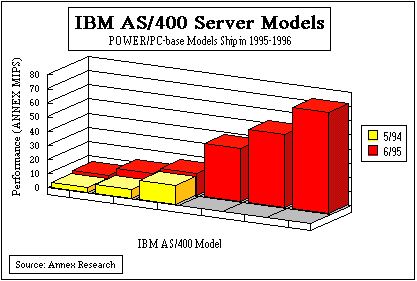
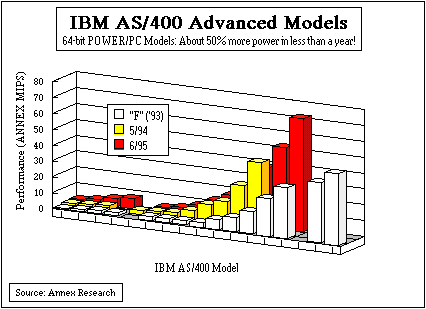
The new AS/400 Advanced 36, the first IBM system to use the
64-bit POWER/PC chips, had to be built anyway so as to test the new
technology, according to Glenn Van Benschoten, the manager of AS/400
hardware development. "So
why not test it under the lower demands of S/36 customers, while
offering them an attractive way to upgrade for their old system?,"
the Rochester team reasoned. Why
not indeed? Except that it
seemed unorthodox, at least in the AS/400 world[5].
But the Rochester team battled on, refusing to take
"no" for an answer from some "doubting Thomases" on
the AS/400 HQ staff.
The
rest is history...
|
|
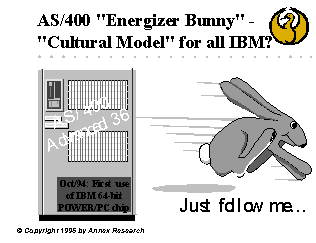
The
Rochester team got its "Energizer Bunny" to go with its
field test. The
growth-minded S/36 customers will get an upgrade option which is five to
eight times more powerful than their present system.
And they will be ready for object-oriented upgrades once they
become available on the AS/400. The IBM treasury will get an unexpected cash infusion from
the new technology instead of a bigger lab bill.
Finally, the company's senior management will be able to point to
this story an example of "people power" at the "new
IBM." As a result,
even those who had initially opposed the idea will now be able to share
the benefits of a brilliant marketing move - by the engineers!
The preceding anecdote, which Bill Zeitler, the former IBM AS/400 assistant general manager, shared with a group of consultants in San Francisco in 1994, exemplifies why the IBM Rochester people have been so unique. And why they've become so uniquely successful. "Gerstner's challenge is to figure out how to transplant the Rochester model elsewhere in IBM," said one former IBM executive who has worked with, but was never directly responsible for the Rochester operation. "These people really know their customers and their marketplace." r
Gerstner Delivers “Vision II”
(from ANNEX BULLETIN 96-15, 3/04/96)
Nick Donofrio, the head of IBM server businesses, picked up right from where (the IBM chairman) Gerstner left off in his Mar. 4 address to analysts in New York). Not just in terms of content, but also by displaying an almost evangelical zeal about the righteousness of the IBM strategies.
“We continue to focus maniacally on the competitiveness of our server platforms,” Donofrio said right off the bat. He added that both the AS/400 and the S/390 systems hold the No. 1 market share positions in their markets., while the RS/6000 and the PCs are among the top three.
AS/400. Donofrio said that there are now over 360,000 AS/400s installed worldwide, along with about 150,000 S/36s. The AS/400 market now has about 10 million end users running some 28,000 applications, most of which were developed by its 8,000 business partners. And even though 1995 was the year in which the AS/400 tried to go through a “transformation without disruption” (to customers), as Donofrio put it, it still managed to attract new customers to the tune of 20% of total shipments. That’s because the AS/400 has been proven to offer the lowest overall cost of ownership of any system, said Donofrio, citing an industry study in support of this claim.
Why are these AS/400 virtues not more widely known on Wall Street, even if Main Street is in love with the product? Because “people tend to focus on the purchasing event, not the owning event,” explained Donofrio. r
Table
1 - AS/400 Financial Results

"THE
END"
[1] Based on the Deutsche Bundesbank statistics.
[2] Hungary and the Czech Rep. had the $3,700 per capita GDP in 1995, versus $2,900 in Russia and $2,300 in Poland.
[3] “Silverlake,” the name of a small lake in Rochester, MN, was the IBM code name for the AS/400.
[4] The six top U.S. multinationals are: 1. GE; 2. Ameritech; 3. US West; 4. GM; 5. Alcoa; 6. Ford.
[5]IBM's mainframe developers have often introduced new chip technology first in smaller, air-cooled systems, before shipping them in volume in the top-of-the line machines.
To subscribe to the on-line editions of our reports, just click on .


